A sold-out audience at London's Barbican Hall was treated to a glorious and affectionate evening of music, celebrating the life and legacy of the great pianist Alfred Brendel. The special concert took place on what would have been Brendel's 95th birthday, just months after his passing in June, and brought together an extraordinary assembly of his colleagues, friends, and protégés.
A Star-Studded Tribute of Sound and Spirit
The atmosphere was one of relaxed joy rather than sombre reverence, with the music firmly at the forefront. An ad-hoc orchestra, comprising leading orchestral and chamber musicians, responded with palpable enthusiasm to the conducting of Sir Simon Rattle. The programme reflected Brendel's own deep passions, leaning heavily into the classical repertoire. It opened powerfully with Haydn's Representation of Chaos from The Creation.
The event also served as a fundraiser for the Alfred Brendel Young Musician's Trust, which provides students with access to professional-standard pianos. However, the focus remained squarely on the musical tribute, with a notable lack of formal speeches enhancing the informal, celebratory mood.

Pianistic Tributes and Playful Moments
The stage was graced by numerous pianists who considered Brendel a mentor. Imogen Cooper accompanied soprano Lucy Crowe in a sublime performance of a Mozart aria. Later, Tim Horton duetted with Brendel's cellist son, Adrian Brendel, in a deeply felt rendition of Liszt's Elégie No 2, while Till Fellner and Paul Lewis teamed up for Schubert's A minor Allegro.
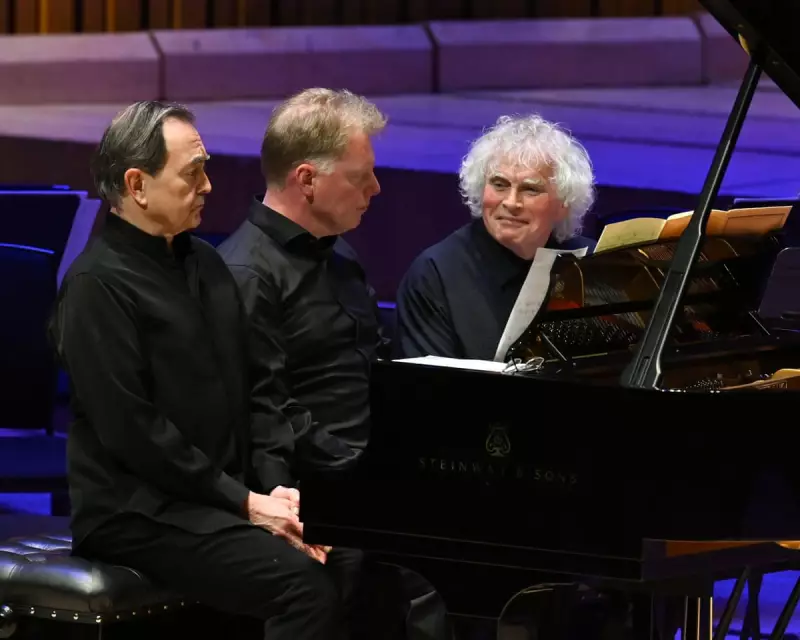
The evening was punctuated by moments of warm, often surreal humour. A recurring bit involved six pianists and their apparently non-interchangeable piano stools. The audience also fell eagerly into Haydn's trap, applauding the false ending of his Symphony No 90 not once, but twice. A highlight of the musical comedy was a brief, obscure piece for 'three left hands' by Mauricio Kagel, which saw Simon Rattle, Tim Horton, and Pierre-Laurent Aimard crowded around a single keyboard.
Sublime Playing and Poignant Farewells
Amidst the silliness, the playing was frequently sublime. A sequence of Brendel's own drily witty poems, interspersed with miniatures by Kurtág and Ligeti, was delivered with brilliant contrast by actress Harriet Walter and pianist Pierre-Laurent Aimard. This segment was bookended by a shambolic, scarlet-coated military band performing Kagel's Marches to Fall Short of Victory.
For many, the emotional core of the night was the slow movement from Schubert's C major Quintet, performed by the Takács Quartet joined by Adrian Brendel. The music spoke eloquently of absence, acceptance, and thankfulness. The concert concluded with a weighty and convincing performance of Beethoven's Piano Concerto No 3 by Paul Lewis, moving seamlessly from the preceding surreal marches into its tense, tiptoeing opening.
The evening stood as a perfect testament to Alfred Brendel: a celebration that balanced rigorous intellect with mischievous humour, and profound musicality with warm, human affection.