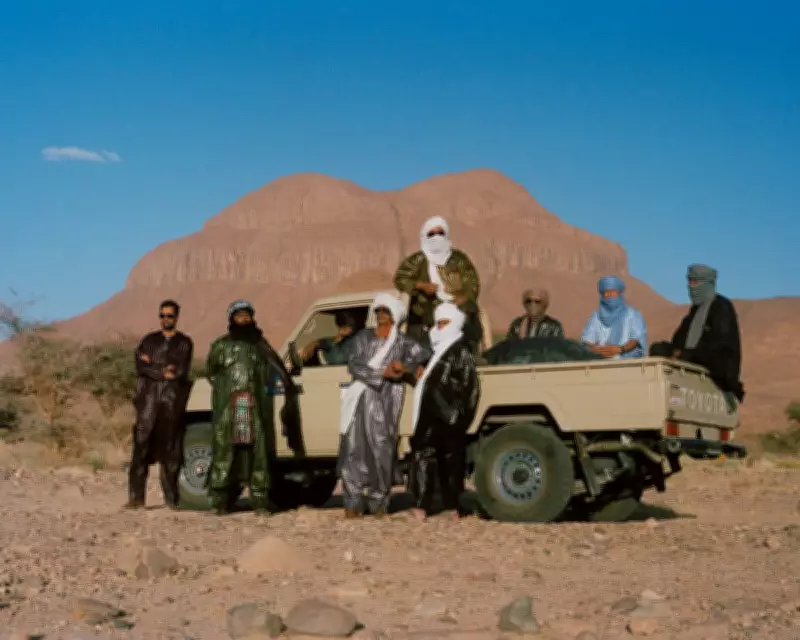
Tuareg Music's Fight for Survival: Tinariwen and Imarhan Raise Voices Against Conflict
Since their formation in 1979, the Tuareg guitar band Tinariwen has embodied a life of constant movement. Based variously in Mali, Libya, and Algeria, the Grammy-winning group has crafted their signature desert blues as a poignant lament for a wandering refugee existence that persists to this day. Co-founder Abdallah Ag Alhousseyni reveals the band is currently sheltering in Algeria after members were forced to flee their homes in Mali in October 2024.
"The Malian military and the Russian mercenary group Wagner have been burning villages, slaughtering animals, and committing atrocities against women," Alhousseyni states. "No politicians or journalists are talking about this, so we must use our music to alert the world." While the Tuareg people are traditionally nomadic across the Sahara, escalating regional politics have repeatedly thrust them into violent confrontations.
Hoggar: An Album Born from Conflict
Most recently, clashes on northern Mali's border involving Islamist militants, the Malian military, Tuareg rebel groups, and Wagner mercenaries have triggered mass displacements and severe human rights abuses. This harrowing conflict takes center stage on Tinariwen's 10th studio album, Hoggar. Across eleven tracks, the group blends the gentle, camel-like gait of classic Tuareg rhythms with finger-picked guitar lines and the husky power of vocal harmonies.

On Aba Malik, a sparse, swelling guitar melody accompanies a clattering tende drum rhythm, while co-founder Ibrahim Ag Alhabib's emotive baritone condemns Wagner's abuses, exclaiming: "Curse you Wagner / Curse your mother!" The rollicking, bluesy Erghad Afewo addresses tribal infighting among Tuareg people, and the soaring guitar tones of opener Amidinim Ehaf Solan buoy Alhabib's hopeful lyrics about discovering a green, pleasant homeland.
"We don't seek independence, only autonomy," Alhousseyni explains, speaking from Paris during a tour. "We desire a safe place for our people in the Azawad region of northern Mali. We are all refugees in Algeria now, with nowhere else to go, though we've done nothing wrong."
From Refugee Camps to Global Acclaim
More than protest music, Tinariwen's rock-influenced desert blues has captivated audiences worldwide over 48 years. Robert Plant once said, "This was the music I'd been looking for all my life," and Jack White invited them to record their 2023 album Amatssou in Nashville. Swedish-Argentine singer José González, a fan of "their hypnotic guitars and meditative songs with uplifting collective singing," features on Hoggar.
Founding members first met as teenagers in an Algerian refugee camp, later moving to Libya where they were briefly enlisted in Muammar Gaddafi's paramilitary with a broken promise of citizenship. Relocating to Mali in 1989, they swapped weapons for guitars, starting as a wedding band whose bootleg cassettes spread among displaced Tuareg communities.
"When we began, we had no internet and didn't know what was possible," Alhousseyni recalls. "We lived in the bush, playing weddings, so the global spread of Tuareg music surprised us all." International recognition came in 1998 when French folk ensemble Lo'Jo shared a festival bill in Bamako, leading to tours in France and their first globally available release, The Radio Tisdas Sessions, in 2001. Since then, Tinariwen has graced stages worldwide, winning a Grammy for 2011's Tassili and gaining fans like Kurt Vile and Cass McCombs.
The Next Generation: Imarhan's Aboogi Studio
Hoggar celebrates Tinariwen's influence intergenerationally. Instead of recording live in the desert—the traditional Tuareg method—they found sanctuary in Tamanrasset, Algeria, at a studio founded by younger Tuareg group Imarhan. "Hearing Tinariwen's second album as a teenager blew me away and inspired my own music," says Imarhan frontman Iyad "Sadam" Moussa Ben Abderahmane. Imarhan built their studio, Aboogi, after losing energy and inspiration recording in Paris.

"Tamanrasset has the most Tuareg people in Algeria, and here guitars are like footballs in Brazil—everyone has one," Sadam notes. "But there's no infrastructure for young people to record; they must pay to go abroad. We needed to create something here for ourselves." Aboogi's open-door policy attracted Tinariwen, allowing collaborative sessions with artists like Sadam, who duets on Tad Adounya and plays guitar on Amidinim Ehaf Solan.
Other guests include original member Liya ag Ablil, returning after 25 years, and José González on Imidiwan Takyadam. Notably, female singers Wonou Walet Sidati and Nounou Kaola provide backing vocals, addressing a decline in women's participation in Tuareg music. "Eighty percent of traditional Tuareg music is women's voices, but it's been hard to find female singers recently," Sadam explains. "With Aboogi, more young women are arriving, curious to sing or make music, which is promising for the future."
Preserving Heritage Amid Ongoing Struggle
Kaola also features on Imarhan's latest album, Essam, which expands Tuareg sound with electric guitar, hand percussion, synths, and electronic textures from French artist Emile Papandreou. "I'd never really heard electronic music before, but we wanted to try something new," Sadam admits. "We've had good feedback from our community; it could be the next step in Tuareg music." Currently touring with Tinariwen, Sadam aims to preserve broader Tuareg culture, including Imzad music and Tamasheq poetry.
"We're only presenting a small part of our heritage with these bands," he says. "With Aboogi, I want an archive to record all Tuareg music and way of life so it isn't forgotten." Meanwhile, Tinariwen continues to tour and record, raising awareness of the Tuareg plight. "We're getting older, some almost 70, so touring is harder," Alhousseyni concludes. "But we want people to hear that our land, people, and animals are being killed. We need peace, and until then, we have no choice but to keep singing." Hoggar releases today on Wedge, while Essam is out now on City Slang.