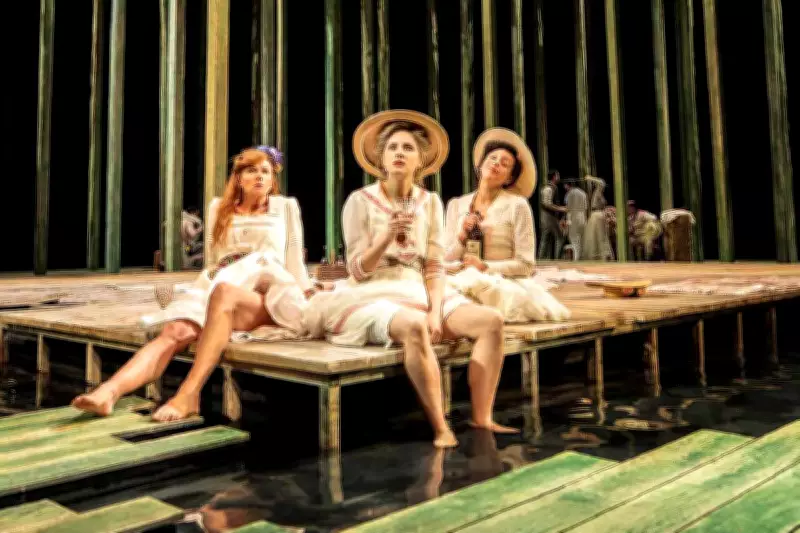
Summerfolk at the National Theatre: A Masterful Bourgeoisie Dissection
Maxim Gorky stands as a colossal figure within the Russian literary canon, a playwright whose name resonates alongside giants like Gogol, Pushkin, and Chekhov. Yet, his works are infrequently staged on British shores, a cultural gap highlighted by the fact that many Londoners have likely encountered more parks named after him than productions of his plays. This oversight is spectacularly corrected by the National Theatre's current, languorous production of Summerfolk at the Olivier, directed by Robert Hastie, known for Standing at the Sky's Edge.
A Brilliantly Directionless Skewering
The play presents a vast ensemble of at least twenty characters, the titular "summerfolk," who migrate to their country houses for a stifling vacation. Their central diversion is an amateur production of Shakespeare's A Midsummer Night's Dream, a fitting backdrop for their own tangled dramas. This is a world where everyone is either hopelessly in love with the wrong person or simply adrift in hopelessness. They engage in endless, melancholic discussions about poetry and suicide, making only half-hearted attempts at either pursuit.
As one character poignantly describes it, they suffer from a "toothache of the soul." These individuals are profoundly detached from the land their ancestors once worked, yet they lack the discretion to wear their newfound wealth with grace. Gorky, a committed socialist later embraced by the Soviet regime, harbored no affection for the nouveau riche, and his critique here is both ruthless and efficient.

An Ensemble of Tragicomic Vignettes
The narrative unfolds through a series of overlapping, tragicomic vignettes, creating a loose and louche tapestry of bourgeois life. Varvara Bassova is mired in depression due to her boorish, drunken husband Sergi. Her spirits briefly lift with the reappearance of a novelist she once admired, only to be dashed when she discovers he has gone bald. Her brother Vlass, portrayed with drunk rag-doll physicality by Alex Lawther, is hopelessly in love with the much older Maria Lvovna. While she reciprocates his feelings, she cannot overcome the social embarrassment of pursuing the affair.
Olga, brilliantly played for laughs by Gwyneth Keyworth, spends her days lamenting how terrible her life has become since having children. Yulia makes no effort to conceal her flirtatious affair with fellow amateur thespian Nikolai. These stories, and many more, weave in and out of focus, capturing the listless disdain and existential conflicts of the middle classes.
A Paean to Russian Literary Tradition
The production is deeply intertextual, serving as a paean to the great Russian miserabilist tradition. Shakespeare is performed, Tolstoy is name-checked, and the spirit of Chekhov is woven throughout the narrative like the lettering in a stick of Blackpool rock. The play grapples with the grand conflicts of existence: truth versus lies, action versus apathy, and genuine loveliness versus the mundane social niceties that define bourgeois life. Yet, it wears these weighty themes lightly, examining them with the same listless disdain its characters exhibit.
This large-scale, ensemble-driven affair demands a stage of the Olivier's grandeur, and Hastie's production rises magnificently to the occasion. It is a wonderful, languorous exploration that reveals exactly what audiences have been missing by neglecting Gorky's work. The National Theatre's Summerfolk is a brutally efficient condemnation cloaked in wit, a must-see for anyone interested in sharp social satire and masterful theatrical craft.