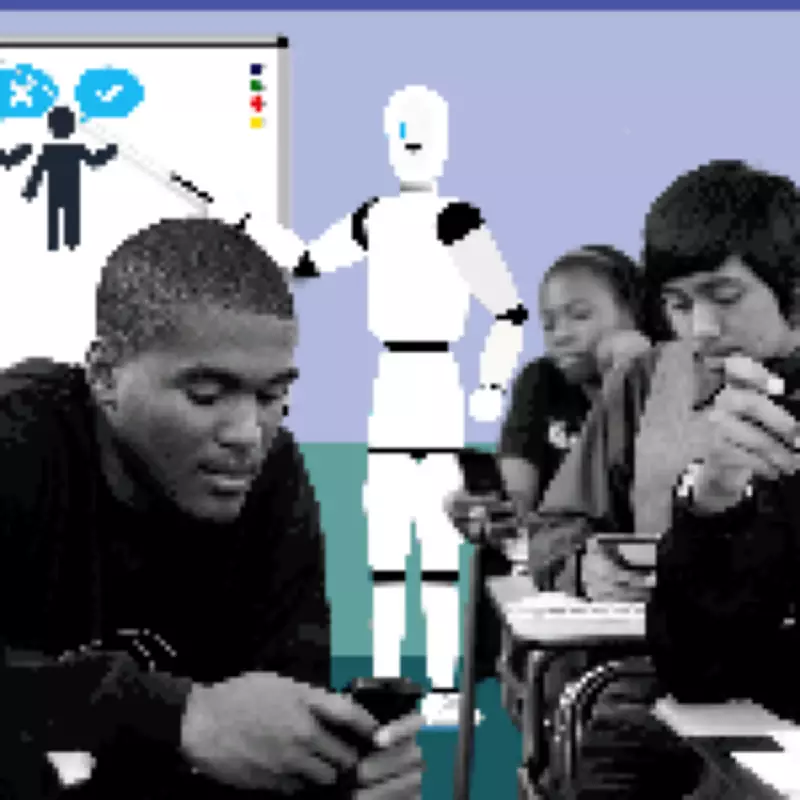
AI Chatbots Are Diminishing Students' Ability to Hold Conversations, Teachers Report
A concerning new survey indicates that young people's reliance on AI-powered chatbots is significantly impairing their capacity for meaningful conversation. According to findings from the National Education Union (NEU), 66% of secondary school teachers observe a decline in pupils' critical thinking skills directly linked to these novel technologies. This figure more than doubles the proportion of primary school teachers who share the same concern, highlighting a growing educational challenge.
Teachers Witness Declining Dialogue and Critical Engagement
In February, educators reported to the union that as children increasingly treat machine algorithms as 'friends,' their need for verbal interaction diminishes. Most chatbots operate through text input on phones or laptops, with generative AI models responding almost instantly. This dynamic, teachers argue, reduces opportunities for developing conversational fluency and argument formation.
One anonymous English teacher and NEU member explained to Metro that with all homework being online at his school, it has become 'easy' for students to cheat using tools like ChatGPT. 'Even when asked to handwrite their answers, some have got an AI to write up an answer to then copy by hand,' he revealed. Students can effortlessly 'parrot' taught material but struggle significantly with constructing independent arguments.

Widespread AI Adoption Amidst Mixed Results
Despite these concerns, AI tool usage among teachers has surged dramatically. Currently, 76% of educators use AI daily, up from just 53% the previous year. Among 9,400 surveyed teachers, primary applications include creating resources (61%), lesson planning (41%), administrative tasks (38%), and marking (7%). However, the effectiveness remains questionable.
'AI marking was used for some assessments recently and it was so inaccurate that the department decided not to use it again,' the NEU member noted, underscoring the technology's current limitations in educational contexts.
Government Pushes AI Tutors Despite Teacher Skepticism
The UK government aims to implement 'AI tutors' by the end of 2027, potentially benefiting over 450,000 children from disadvantaged backgrounds. Officials suggest these tools could save teachers time and customize learning experiences. This initiative follows international trends, with some US school systems already incorporating chatbots, and Iceland launching the world's first national AI education pilot.
Alex Russell, CEO of Bourne Academy Trust, advocates for UK teachers to embrace AI, noting that many schools now use machine learning to 'reduce workloads' after initial hesitation. 'Across the profession, there is some anxiety and inconsistent adoption, but we generally accept that it's now part of the landscape,' Russell observed.
Policy Gaps and Tutoring Alternatives
The NEU survey revealed that 49% of schools lack any formal policy governing AI use by staff or students. Furthermore, fewer than one in six schools offer tutoring programs, often due to budget constraints or staffing shortages. Libby Hills, founder of research organisation EdTechnical, suggests AI tutoring could address this gap.
'AI has made it possible to deliver something meaningfully close to that kind of support for a fraction of the cost,' Hills explained. 'For many schools, the relevant comparison isn't AI versus a brilliant private tutor, it's AI versus no tutoring.'
Cognitive Offloading and Curriculum Integration Concerns
As the first generation to grow up with AI, today's students face unique challenges. Hills warns of 'cognitive offloading,' where students using general-purpose chatbots like ChatGPT in unstructured ways may perform better with the tools but worse without them, having relied on AI rather than developing their own understanding.
Teacher skepticism remains strong, with only 14% supporting the government's AI tutor plans for disadvantaged pupils. 'AI tutors are a waste of time, at the very least, for humanities subjects,' the NEU member argued. 'AI might be able to explain why an equation is wrong, but they can barely mark an English essay correctly.'

The government maintains that 'no technology should replace the foundations of core knowledge and disciplinary thinking that prepares pupils for later life. But we also have to prepare children for a digitally enabled world.' This balancing act between technological integration and preserving fundamental educational skills continues to challenge educators nationwide.