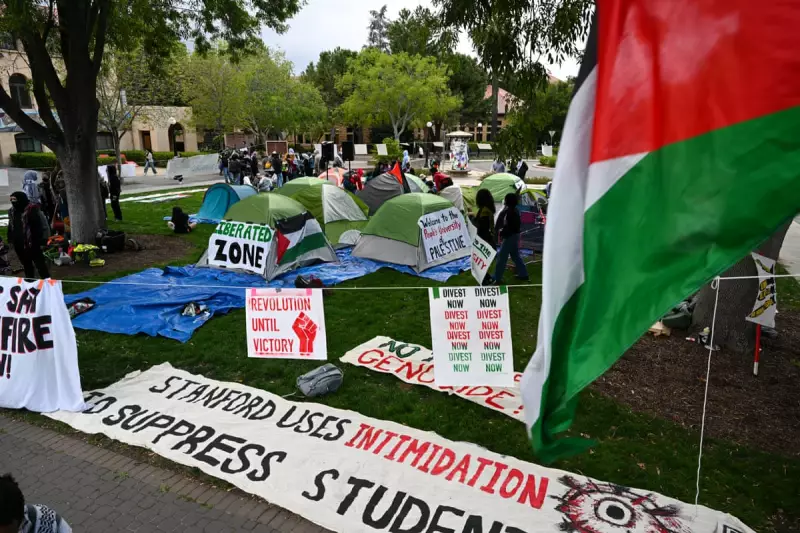
Five students from Stanford University in California are set to face a jury trial beginning Monday, 5 May 2025, on serious felony charges connected to a pro-Palestinian protest on campus last year. This case represents the most severe criminal prosecution to emerge from the wave of nationwide student demonstrations against Israel's military actions in Gaza.
The Protest and the Charges
The charges stem from an hour-long occupation that took place in June 2024. A group of students barricaded themselves inside the university president's office, demanding that Stanford consider divesting from Israel. During the action, they unofficially renamed the building after Adnan al-Bursh, a Palestinian surgeon who reportedly died under torture in Israeli detention.
Initially, 12 students were charged with felony conspiracy to trespass and felony vandalism. Of those, one cooperated with prosecutors and was not indicted, while several others accepted pre-trial plea deals. The five remaining students, who have pleaded not guilty, are now proceeding to trial at the Santa Clara County Superior Court in San Jose.

At a press conference in April 2025, Santa Clara County District Attorney Jeff Rosen announced the charges, stating, "dissent is American, vandalism is criminal." He emphasised that the political motivations of the protesters were "legally irrelevant." The university suspended the students immediately after their arrest and banned them from campus for two terms, later allowing them to return in the fall of 2024 following an internal disciplinary process.
A Case of Unique Severity
This prosecution stands out for its harshness. While thousands of students were arrested during the 2024 campus protests across the United States, most criminal charges were dropped. For instance, prosecutors in New York and Los Angeles declined to charge dozens of arrested students, and Michigan's attorney general dropped charges against protesters at the University of Michigan.
The Stanford defendants are among the first to face trial and the only ones charged with felonies, which are more serious than the misdemeanours typically levelled at protesters. If convicted, they face the possibility of more than three years in prison. Stanford is also seeking $329,000 in restitution from the group for alleged damage, a figure the students contest as "completely overinflated." The university's own facilities director testified the damage was under $10,000.
Defendants' Perspective and Broader Context
In an interview, defendants German Gonzalez and Amy Zhai argued their prosecution is politically motivated and designed to deter future activism. "This is all just a distraction from the very real property destruction and crimes that are occurring in Gaza every day," said Gonzalez, a sophomore at the time of the protest.
Zhai highlighted a chilling effect on campus, with pro-Palestinian students now afraid to voice opinions in class. The students intend to use the trial, expected to last five weeks, to criticise Stanford's investments and its partnership with weapons manufacturer Lockheed Martin.
Prosecutors attempted, unsuccessfully, to ban the defendants from discussing "genocide" or their political motivations during the trial. However, they successfully blocked the defence from calling an international human rights expert and from invoking First Amendment free speech protections.
Gonzalez linked the severity of the charges to what he termed the "Palestine effect," where systems are "stretched to its absolute limit" to punish dissent. He also questioned DA Rosen's motives, pointing to Rosen's greeting of Israeli Prime Minister Benjamin Netanyahu on a tarmac in September 2023.
The trial unfolds as a pivotal test of the legal limits of protest and the consequences for student activism surrounding the conflict in Gaza.