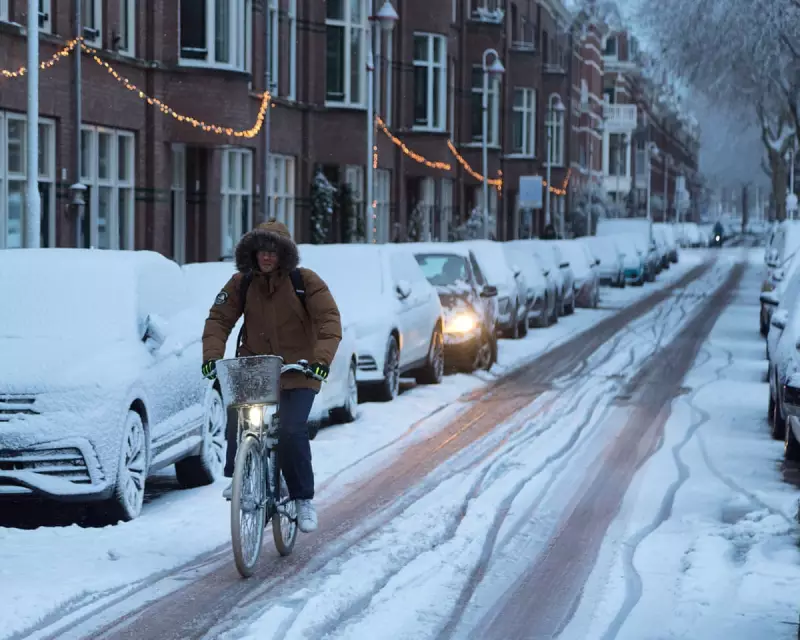
A rare and disruptive winter cold snap has paralysed the Netherlands, exposing a nation increasingly unaccustomed to dealing with significant snowfall. What would once have been a normal week of winter weather has instead triggered widespread transport chaos, thousands of flight cancellations, and mounting public frustration, particularly among the country's legion of cyclists.
Transport Gridlock and Cycling Frustration
Since Saturday, up to 15cm of snow has fallen across the country, with temperatures plunging to -10C (14F) including wind chill. The national infrastructure has struggled to cope. More than 20,000 flights have been cancelled, roads and railways descended into disarray, and there have even been reports of buildings partially collapsing under the weight of snow.
However, a prominent source of anger has been the state of cycle lanes compared to roads. Environmental consultant Vincent Luyendijk voiced his frustration on social media, sharing photos of children forced into traffic in Rotterdam because bike paths were impassable. "I was blue in the face with frustration," he said.

The national Fietsersbond cycling union is investigating after numerous reports of severe inconvenience. In Hilversum, volunteer Marjolein van Dillen told Dutch media that bike lanes were in such a dangerous state that people dared not use them, while adjacent roads were clear. "There was a whole ridge of snow, pushed to one side on the bike lane," she explained.
A Nation Out of Practice
The core of the problem, according to experts, is simple: the Netherlands no longer experiences enough cold weather to maintain its preparedness. Data from the Royal Netherlands Meteorological Institute (KNMI) starkly illustrates the change. In 1961, its weather station at De Bilt saw snow cover for an average of 23 days a year. Now, that figure has plummeted to just three days a year.
"We just don't have the winters that we had in the 20th century," said Wiebe Wieling, former chair of the Elfstedentocht Association, which organises a famed ice-skating tour that hasn't run since 1997. "It's a Dutch frustration. It's a climate frustration."
This lack of routine has had cascading effects. The motor trade association Bovag reported cars skidding off roads partly because drivers failed to fit winter tyres in October. National airline KLM had to urgently source 100,000 litres of de-icing fluid from Germany after running out. Meanwhile, rail operator ProRail faced a barrage of complaints over delays, especially as Switzerland's network continued to function smoothly.
The Economic and Climate Cost
Rico Luman, a senior economist at ING, noted that the economic cost of this failure will be calculated later. He pointed out that with ice days falling from around ten to just three per year on average, massive investment in winter contingency plans is often deemed not worthwhile. "The damage is piling up and it's not over yet," he warned.
Climate scientist Hylke de Vries explained that the Netherlands' typical westerly winds from the North Sea usually bring mild conditions. "The Netherlands has never been a country where lots of snow was the norm, but with climate change, these cases decrease quite considerably. So when it happens, then everybody is surprised." KNMI modelling suggests that without global heating, this week's average snow cover of 5cm would have been 9cm, with some areas receiving 22cm.
Meredith Glaser, CEO of the Urban Cycling Institute, argued this makes resilient infrastructure for active travel more critical. "We know that climate change doesn't just mean warmer – it means more extreme and unpredictable weather," she said. "Snow doesn't necessarily stop people from cycling. But poor maintenance does."

Despite the chaos, the iconic Dutch cycling spirit persists. Fonger Ypma, founder of an Arctic ice-thickening project, posted a snowy office selfie from Delft on LinkedIn, noting the stubborn habit of cycling to work. Yet he observed a generational shift: "The younger generation is not so used to it. It fades away quite quickly if the snowy weather doesn't occur any more." This week's paralysis serves as a stark reminder of the challenges posed by a rapidly changing climate to even the most organised of societies.