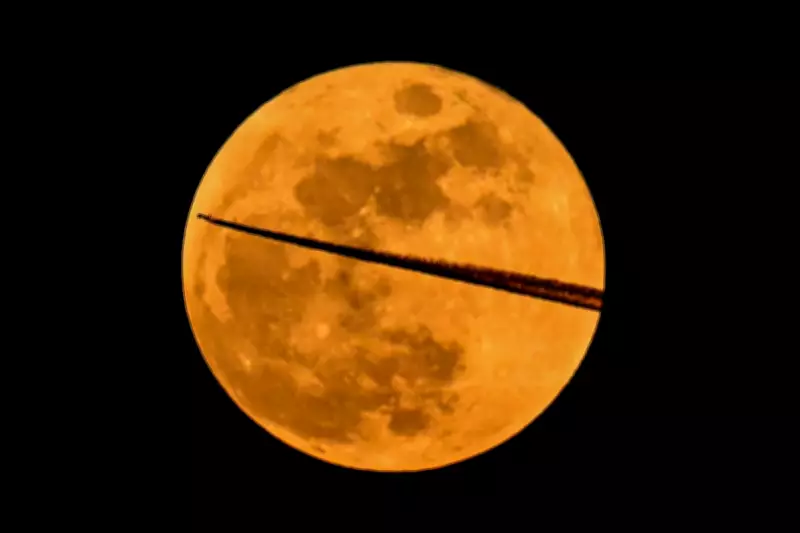
On Tuesday night, a rare total lunar eclipse unfolded across the skies, resulting in a breathtaking blood moon phenomenon that captivated observers worldwide. The celestial event was first visible in Western Australia before progressing through parts of Asia, Europe, and North America, offering a stunning visual spectacle.
Global Observations of the Blood Moon
The eclipse provided dramatic backdrops against iconic landmarks and natural settings. In Frankfurt, Germany, a Bulgaria Air plane was photographed flying past the blood moon, creating a striking juxtaposition of human technology and natural wonder. This event marked the last opportunity to witness a blood moon total lunar eclipse for nearly three years.
Asia-Pacific Region Views
Across the Asia-Pacific region, the eclipse was particularly visible. In Seoul, South Korea, the moon rose majestically above the Lotte World Tower, while in Auckland, New Zealand, observers at the Te Whatu Stardome captured the complete transformation. Indonesian high school students in Bandung, West Java, used telescopes at the Winaya Observatory SMA BPI 1 to study the phenomenon closely.

Mediterranean and American Perspectives
The Mediterranean Sea near Limassol, Cyprus, provided a serene setting for the eclipse, while in Los Angeles, California, the full moon took on a distinctive coppery-red hue as it entered Earth's shadow. Further south, stages of the eclipse were documented in San Salvador, El Salvador, and Pachuca, Mexico, where the alignment of Earth between the moon and sun created the shadow effect.
Cultural and Religious Contexts
The eclipse coincided with Makha Bucha celebrations at Wat Phra Dhammakaya Buddhist temple in Pathum Thani province, Thailand, adding spiritual significance to the astronomical event. In Myanmar, observers gathered at Inya Lake in Yangon to watch the sky, while in Italy, the moon appeared dramatically over the towers of Molfetta cathedral.
Photographic Documentation
Photographers employed various techniques to capture the event, including multiple exposure combinations in Auckland, New Zealand, to document the eclipse's progression. The stunning scene was also recorded from Karang beach in Sanur, Indonesia, showcasing the blood moon against coastal scenery.
Scientific Explanation and Future Events
A lunar eclipse occurs when Earth aligns directly between the moon and the sun, blocking sunlight and casting Earth's shadow onto the lunar surface. This alignment causes the moon to change color, adopting the characteristic reddish tone that gives the "blood moon" its name. The next total lunar eclipse is scheduled for New Year's Eve 2028, making Tuesday's event particularly significant for astronomy enthusiasts and casual observers alike.
The global visibility of this rare celestial occurrence underscores the universal fascination with astronomical phenomena and their ability to connect people across different cultures and continents through shared observation of the night sky.