

London Tests Modular Playgrounds for Global Disaster Zones
As one in six children worldwide is affected by war, a UK charity is stepping up to provide joy and development opportunities in refugee communities from Ukraine to Ethiopia. Playrise, founded by photographer Alexander Meininger, is launching modular, flatpack timber climbing frames designed for disaster relief zones, with prototypes currently being tested in London before deployment abroad.
From Parental Observation to Global Initiative
Alexander Meininger, a German-born photographer now based in London, found inspiration in his own children's play habits. "You end up spending a lot of time observing them in playgrounds – whether you want to or not," he says. After building an indoor treehouse for his sons, the Ukraine war spurred him to think bigger. Witnessing infrastructure destruction on television, Meininger focused on creating affordable, easy-to-assemble playgrounds for displaced families, leading to the launch of Playrise this week.
Meininger explains, "To start with, I thought about collecting usable pieces from rubble in conflict sites, but these communities need something quick and affordable. Just like renting requires Ikea-style furniture, refugee camps need temporary solutions, yet people often stay in such accommodation for depressingly long times."

Collaborative Design for Diverse Needs
To develop the prototypes, Meininger partnered with UK architecture firm OMMX and engineers Webb Yates. Through NGOs like Empowerment for Development and Save the Children, they connected with displaced communities in Egypt and Ethiopia, including the Aysaita camp for Eritrean refugees and sites in Cairo and Karkar for Palestinian and Sudanese refugees.
Hikaru Nissanke, director of OMMX, notes that Playrise aligns with the firm's Young Policymakers scheme, which advocates for children's needs in the building industry. "The project was complex," says Nissanke. "We needed a structure mass-produced for scale yet personal to each community, designing for deserts to cramped courtyards. But we found a universal truth: every child wants to find joy."
Modular and Adaptable Play Solutions
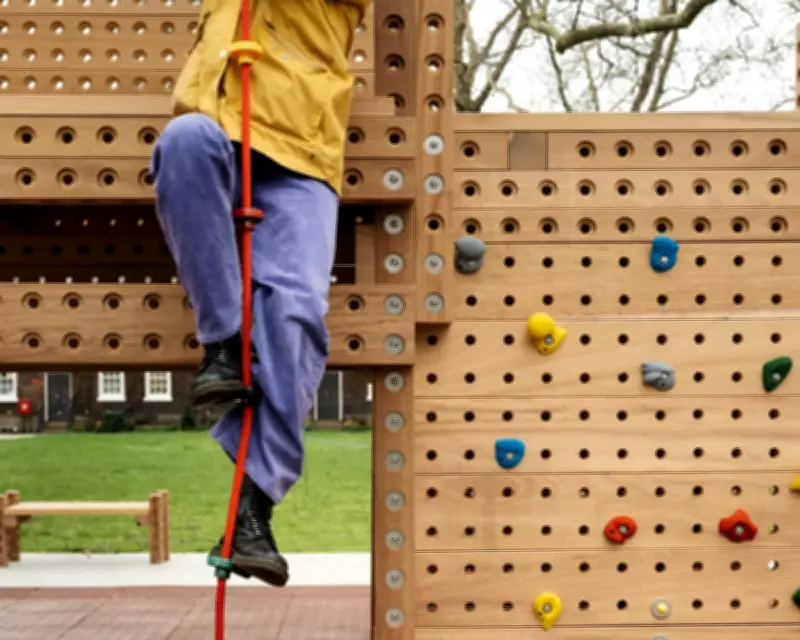
The Playrise prototype features modular iroko hardwood beams and planks fixed with metal bolts, customizable with add-ons like ropes, monkey bars, and basketball hoops. The system can be reconfigured to fit space limits and user needs, with easily replaceable parts and playground-specific security nuts.
Research underscores that play is vital for child development, fostering motor skills, cooperation, and social abilities. However, Unicef reports nearly 50 million children were living in forced displacement in 2025, with young people making up 40% of over 122 million displaced by conflict. The UN Council of Human Rights states nearly one in six children are now affected by war.
Empowering Communities Through Play
The first Playrise set will ship to the Aysaita camp in Ethiopia next month, a site established in 2007 where some children have lived their entire lives. Nissanke shares that children at the camp helped assemble the play structures, gaining practical building skills. "We're equipping them with skills to build and maintain their own homes, which is poignant given their precarious living conditions," he says.
Meininger is focused on scaling the project to ensure availability for NGOs and young people, avoiding a westernized or patronizing approach. "From the countries I've visited, humans wish for the same things, including seeing their kids thrive and play," he reflects. Playrise aims to provide that opportunity in the most challenging environments worldwide.






