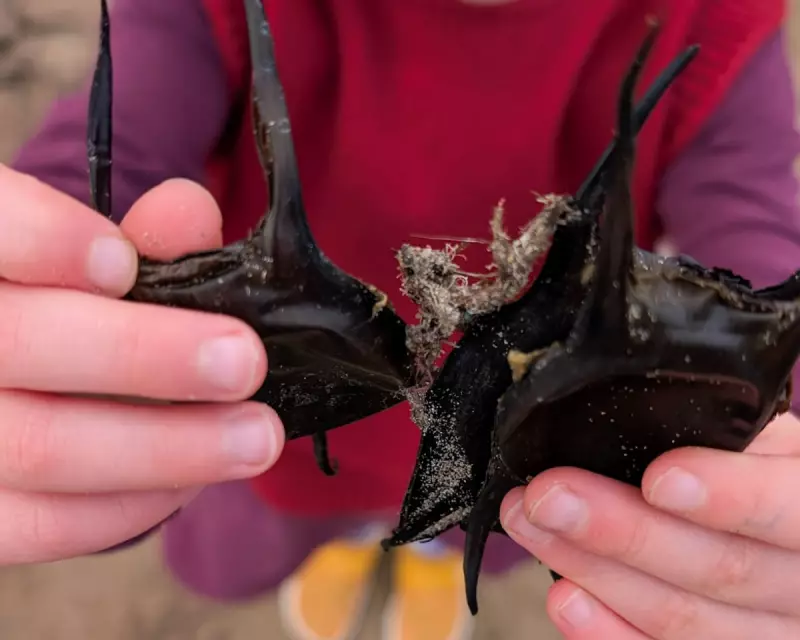
A winter's walk on a Devon beach has revealed a marine marvel, as a father and his young daughter stumbled upon a remarkable treasure trove of natural history. On the reduced sands of North Sands in Salcombe, the pair discovered an unusually dense collection of mermaid's purses, the evocative common name for the leathery egg cases of rays and sharks.
A Rocky Adventure on the Estuary
With two hours until high tide, the beach was a slim crescent of smooth sand. The estuary waters, a mix of grey, blue, and green, were lined with a ragged swell. Undeterred by the chill, winter swimmers waded into the sea. Four-year-old Nina, finding little sand for running, invented a game of mountain goats on the jumble of boulders at the back of the shore.
Navigating the awkward shapes and angles, she mostly found her own balance, with only occasional assistance from a parental 'hoof'. Their playful ascent was watched by a rock pipit and a fox-red wren that whirred into a crevice. With a final, triumphant bleat, Nina bounded down onto the sand below, ready to explore.

The Prized Discovery: A Concentration of Egg Cases
The sand was scattered with shells and storm-torn seagrass, but the duo soon found Nina's favourite beachcombing prize. A few steps revealed not just one mermaid's purse, but another, and then another. The concentration was unlike anything her father had seen before. The green colouration and shiny texture of the cases indicated they had only recently hatched.
The finds were carefully recorded via the Shark Trust app, contributing to their citizen science initiative, the Great Eggcase Hunt project. The specific cases were identified as belonging to two of Britain's most common ray species: the spotted ray (Raja montagui) and the thornback ray (Raja clavata).
From Seabed to Shoreline: The Life of a Mermaid's Purse
These leathery capsules are designed to be tough, protecting the developing embryo for months on the seabed. After the pup emerges, the empty case can endure for many more months before eventually washing ashore. Spawning typically occurs in summer, with an incubation period of five to six months for these species. In contrast, the endangered flapper skate found off northern Scotland has an incubation that can last up to 18 months.
With mountain-goat energy spent, Nina dropped a final purse into her collection bucket, and the pair headed for the warmth of the beach cafe, their simple walk enriched by a direct connection to the hidden reproductive cycles of the sea.