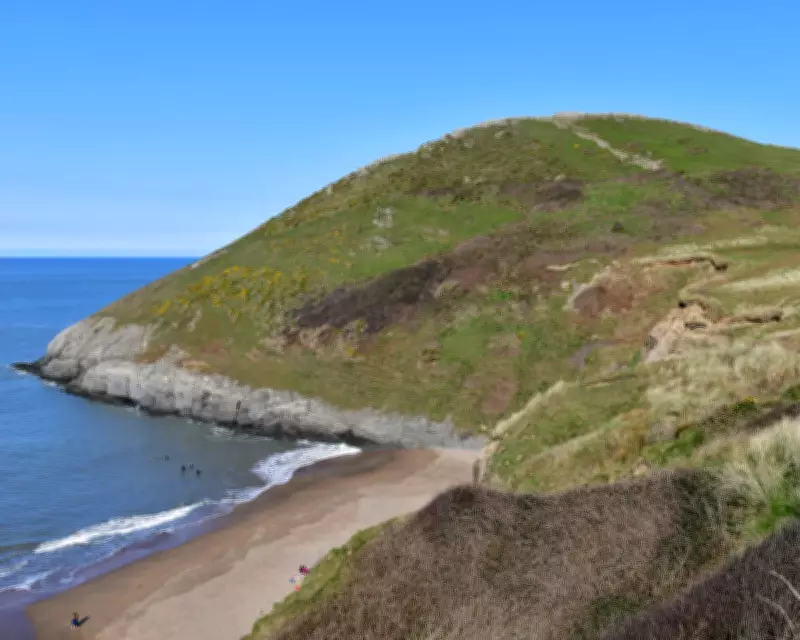
Country Diary: A Truly Special Combination of Beach, Hill, and Church in Mwnt, Ceredigion
There are many isolated spots along this stretch of coastline in Wales, but on a rare sunny day, I take a walk to one of them that stands out for its unique beauty. Looking south from the low cliffs of Gwbert, the steep rock stacks beyond the mouth of the Afon Teifi are blurred by an early morning haze, creating a mystical atmosphere. Below me, a fishing boat heads out to check on the crab pots that dot the coast, pursued by an intent gathering of gulls, adding a lively touch to the serene scene.
The Coastal Landscape and Ancient Geology
To the west, as the shadows harden with the advancing day, the low whale-back shape of Cardigan Island is marked by curved bands of tightly folded rock. This showcases the ancient, resilient Ordovician geology that forms the spine of this coast, a testament to millions of years of natural history. Somewhere above me, a skylark burbles its tangled thread of song in the morning sun, filling the air with melodic notes that enhance the peaceful ambiance.
Discovering Mwnt's Hidden Gem
Heading north, the high coastal plain drops suddenly away to reveal the beach at Mwnt, backed by the steep, isolated hill which gives this place its name. This is a special, favoured location—one to return to at intervals for its timeless appeal. Today, the blue sky, so rarely seen in recent weeks, hangs like a dome over the pale foam of the shoreline. The sunlight picks out the stark white rendered form of Eglwys y Grog, or Holy Cross church, a tiny chapel hunched in the shelter of the hillside, offering a glimpse into local heritage.

The stone-bounded churchyard is home to a pair of stonechats that flit between gravestone perches with their characteristic call, which is uncannily like two pebbles being snicked together. This adds a charming wildlife element to the historic setting, blending nature and culture seamlessly.
Ascending the Hill and Observing Wildlife
I haul myself up onto the narrow shoulder of the hill, past flowering gorse and the brown of last summer's bracken, to where the crest of exposed rock is studded with lichen and wall pennywort. To the north, an array of promontories buttress the land, deeply dissected by steep valleys where streams plunge to the hidden beaches below. Sheep bask in the sudden warmth at the cliff edge, while black corvids weave above me, calling with abrupt, guttural cries that echo across the landscape.
With starkly red beak and legs, these are clearly choughs—a welcome speciality of this coast's ecology. Two of them land close in front of me to pick idly at sheep droppings and strut around expressing apparent displeasure, showcasing their unique behavior. As I watch them, their shadows become diffuse, and looking up, I see that a band of high cloud is moving in to cover the sun. A chill breeze begins to blow, signaling that it's time to move on from this enchanting spot.
This walk through Mwnt highlights the perfect blend of natural beauty, historical significance, and vibrant wildlife, making it a must-visit destination for anyone seeking tranquility and inspiration along the Welsh coast.