

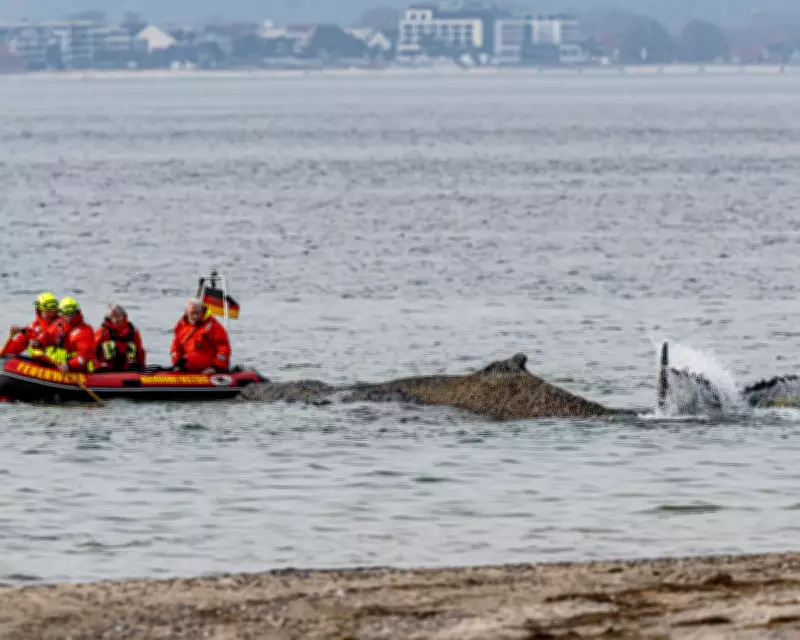
Stranded Humpback Whale Faces Imminent Death on German Baltic Coast
Rescue teams in Germany are racing against time to save a 10-meter-long humpback whale stranded on a sandbar in the Baltic Sea, with experts warning the mammal will die soon if not moved to deeper waters. The young male whale was discovered by hotel guests in Niendorf, located in Lübeck Bay, northern Germany, on Monday after they heard its deep moans and alerted authorities.
Rescue Efforts Prove Unsuccessful Amid Deteriorating Conditions
Since the stranding, local coastguard, fire brigade, and marine rescue teams have worked tirelessly to assist the whale. Their attempts have included removing netting from its body and creating artificial waves to encourage it to swim away. However, these efforts have so far failed, and the whale appears to be weakening rapidly.
Sven Biertümpfel, from the sea protection organization Sea Shepherd, emphasized the urgency, stating, "Every passing hour means a deterioration in his condition. It's only a question of time as to how long he's got to live if he continues to stay lying there." Experts believe the whale needs just one or two fin strokes to reach safety but is too exhausted to make the move.

Challenges and Public Interference Hamper Rescue Operations
Rescue workers face significant risks, including being struck by the whale's flailing tail fin. Efforts were temporarily paused after the animal showed signs of stress and exhaustion. Hopes that higher midnight tides would aid its escape were dashed when the whale briefly turned toward the shipping channel but then reversed direction.
Niendorf's mayor, Sven Partheil-Böhnke, urged the public to stay away, citing reports that onlookers have hindered rescue attempts. Some individuals approached the whale in small boats, while others criticized rescuers for perceived inaction. The beach has been sealed off to prevent further interference.
Experts Advocate for Natural Processes Over Human Intervention
Veterinarians and marine experts on site have rejected calls from the public to administer a lethal injection. Robert Marc Lehmann, a marine biologist, argued, "Nature has to be allowed to take its course. Human intervention isn't always helpful." Dr. Stephanie Groß from the Institute for Terrestrial and Aquatic Wildlife Research suggested the whale may have strayed into shallow waters while hunting fish and either became disoriented or found ample food.
Rising Stranding Incidents Across Northern Europe
This stranding is part of a concerning trend in northern Europe, with at least 10 sperm whales reported stranded in Denmark, Norway, and off the UK coast in recent weeks. In Denmark alone, eight whales have beached within a few weeks, often due to entering too-shallow waters. These incidents highlight growing challenges for marine life in the region.






