Riding the Wild Winds at Cullernose Point
The Northumberland coast presents a landscape of raw, elemental power, and nowhere is this more evident than at Cullernose Point. Here, the dolerite cliffs of the ancient Whin Sill formation thrust a giant, wedge-like promontory as they dramatically taper into the turbulent sea. It is a place that commands attention, a geological spectacle shaped over millions of years.
A Riot of Sound and Sea
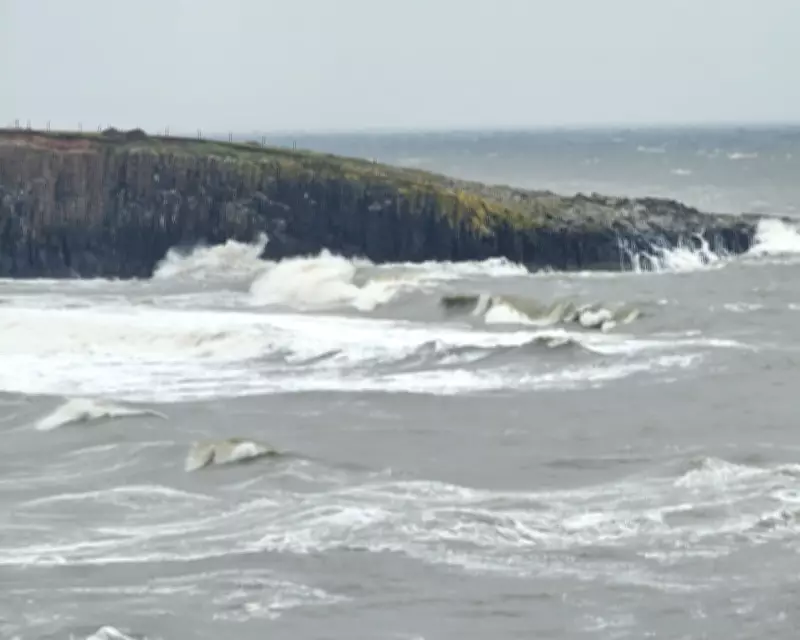
The sea still rages with formidable energy in the aftermath of a recent storm. Waves, higher than I have ever witnessed here, crash against the dark rocks with a force that transforms the North Sea into something resembling a wild ocean. The water, a churning grey-green full of suspended sand, froths and erupts upon impact, bursting skyward with the explosive power of geysers as it collides relentlessly with the land.
This dramatic scenery is thrilling at any time, but today is particularly intense. The sound is all-enveloping, a constant roar. The wind cuts sharply, and the air hangs damp with salty spume, carried inland by the gale.

The Sheltered Path and Open Vista
We take the coastal path heading south, moving initially between high banks of wind-bent scrub. For a brief, sheltered moment, we pass stumpy sycamores and leaning hawthorns, their branches woven by persistent winds and vividly adorned with lime-green lichens. The path is lined with scattered yellow flowers on gorse bushes, sprawling dead grasses and bracken, and the barbed, arching wires of brambles. Frazzled seedheads top the stalks of last year's knapweed, mixed with the fragmented, skeletal remains of hogweed.
Then, the path opens abruptly, and we are thrust into the full force of the weather, rewarded with the finest view of the bay's extraordinary geology. Below us lie the whaleback folds of the lower foreshore, where limestones and sandstones curve gently like collapsed architectural arches. Rising beyond them are the massive, iconic hexagonal columns of the Whin Sill, projecting boldly out into the sea.
Ancient Geology and Modern Life
This spectacular landscape is the result of tectonic movements some 295 million years ago, which allowed molten magma to intrude vertically between older rock formations. The hardened result defines much of northern England's character, providing the hard rock foundation for historic castles, the route for Hadrian's Wall along its cliffs, and the dramatic plummet of waterfalls like High Force.
At Cullernose Point, the fractured planes and columnar structures characteristic of dolerite have created perfect ledges for nesting seabirds. A few pairs of fulmars, appearing as white dots against the grey-brown crags, are already in residence. They will soon be joined by kittiwakes returning from their winter at sea. When they do, the air will resound with their strident yet strangely sweet calls, creating an uplifting soundscape that carries along the Northumberland coast and even into the heart of Newcastle.
Sharing the Sky with the Fulmars
For now, it is the fulmars that command the sky. They circle effortlessly above my head, hanging motionless in the air, perfectly steadied by the counterforce of the gale. My hands are numb with the cold, but the sensation is one of pure exhilaration. Standing here on the cliff edge, a part of me feels as though it is riding the wild wind right alongside these magnificent birds, sharing in the freedom and ferocity of this unforgettable coastal moment.