

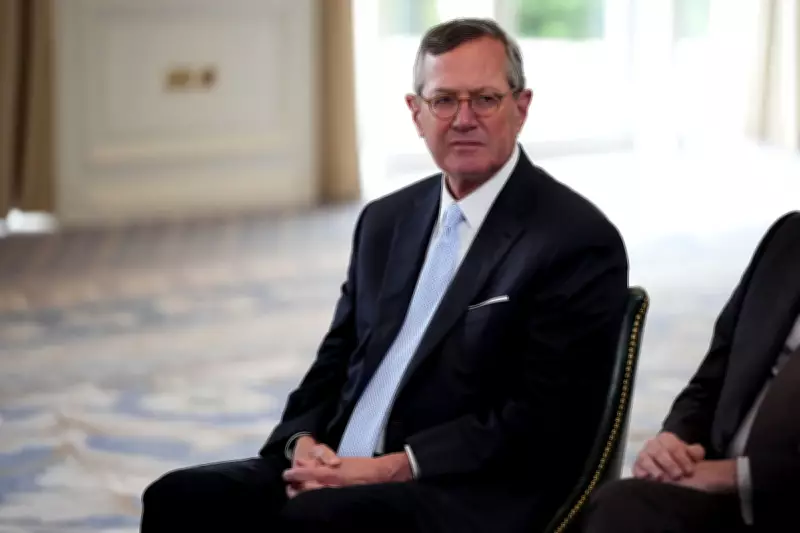
US Ambassador Issues Stark Warning Over UK's European Realignment
Washington's ambassador to the United Kingdom, Warren Stephens, has delivered a blunt message that Britain's pursuit of closer ties with the European Union will "not be viewed favourably" by the White House if it compromises the critical trading relationship between the UK and US. The diplomat's remarks highlight growing transatlantic tensions as the British government seeks to revive economic growth through European realignment.
Trade Agreement at Risk from European Rules Adoption
Ambassador Stephens specifically pointed to the government's recent decision to adopt over seventy European rules onto the UK statute book as a potential flashpoint. He warned that this move could "be a problem" in Washington if it threatens the recently struck bilateral trade deal between the two nations. "The relationship between the US and the EU is a lot more difficult than with the UK," Stephens stated during a British Chambers of Commerce conference in London.
"To the extent that the British government is putting seventy-six laws or rules back on the books, if that affects US trade and requirements, that's going to be a problem," the ambassador emphasized. This warning comes as Prime Minister Keir Starmer and Chancellor Rachel Reeves have championed tighter trading links with the European Union as a key strategy to boost Britain's sluggish economic growth.

Government's European Realignment Strategy
Chancellor Reeves has become increasingly vocal about the economic costs of Brexit, which she identifies as a core factor behind Britain's stuttering economic prospects. Last week, she used a major speech to call for closer realignment with the European Union. As part of these efforts, ministers are preparing to reintroduce a swathe of European directives covering areas such as agriculture and food standards onto the statute book.
While the government has resisted pressure to rejoin the European customs union—a move that would threaten elements of agreements with both the US and India—Stephens cautioned that even these smaller steps toward realignment risk creating another diplomatic rift. He warned that if these changes force officials to revisit any aspect of the recently struck US-UK trade agreement, significant tensions could emerge.
"I know the EU is an important market for the UK, and you've got to do what's best for you, but any encroachment on the UK-US trade relationship will not be favourably viewed in Washington," the ambassador stated unequivocally.
Broader Diplomatic Tensions Surface
The ambassador's comments represent the latest indication of fraying relations between Washington and London, which have spilled over into public exchanges between former President Donald Trump and Prime Minister Starmer regarding Britain's reluctance to engage militarily in the Middle East. Trump recently condemned Starmer as "no Winston Churchill" during a press conference, criticizing his refusal to allow US military attacks on Iran to be launched from British bases in the region.
Meanwhile, the Prime Minister has accused the American president of attempting to pressure Britain into joining offensive operations. These diplomatic spats underscore the complex geopolitical landscape in which the trade discussions are occurring.
North Sea Energy Policy Criticized
Ambassador Stephens also unleashed fresh criticism of the UK's refusal to grant new oil licenses in the North Sea, arguing that Britain could become an energy price setter if it fully utilized its domestic fossil fuel reserves. The ambassador has been a longstanding critic of the government's unwillingness to allow energy companies to drill for new oil, previously stating that this policy makes the UK a difficult place to conduct business.
Speaking at Thursday's industry conference, he told delegates that both British and American firms are being deterred from investing due to the UK's sky-high energy costs. "The UK could certainly have more influence over its domestic energy price, if not be a price setter by using its domestic fossil fuel reserves," Stephens asserted.

He continued: "The solution here is energy addition, not subtraction. In the modern economy, we need all forms of energy on the table, including oil and gas." This perspective contrasts sharply with the UK government's current environmental and energy security policies, highlighting another area of transatlantic disagreement.
The ambassador's dual warnings—regarding both trade relations and energy policy—paint a picture of increasing strain in the special relationship at a time when Britain is attempting to navigate its post-Brexit economic strategy while maintaining crucial alliances.





