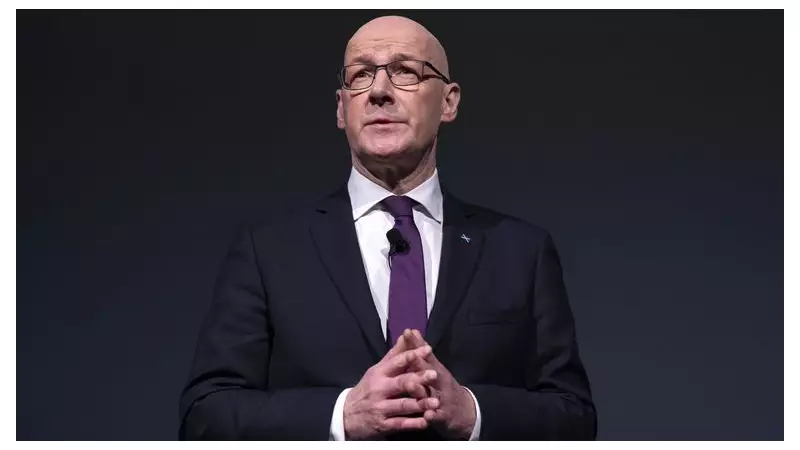
Scotland's First Minister, John Swinney, has declared that securing a majority for the Scottish National Party (SNP) in the upcoming May election would serve as an unequivocal mandate to demand a second independence referendum.
Election Framed as Crucial Independence Test
Speaking on Sky News' Sunday Morning with Trevor Phillips programme, Swinney stated that the SNP must perform "really well" in the forthcoming vote for another referendum to become a reality. When asked if the May polls constituted an "independence election," he was direct in his response.
"I'm being straightforward with people in Scotland that if people in Scotland want Scotland to become independent, the SNP has got to do really well in this forthcoming election," Swinney said.

He pointed to the historical precedent set in 2011, when an SNP majority in the Scottish Parliament led directly to the 2014 independence referendum. "It's got to achieve a majority... because when that happened before in 2011, it led to a referendum in 2014," he argued.
Challenging Westminster's Authority
The interviewer pressed Swinney on what would happen if a future UK Prime Minister, Sir Keir Starmer, refused a request for a second referendum. The First Minister outlined a two-pronged argument.
Firstly, he invoked the principle of the United Kingdom as a "partnership of equals," asserting Scotland's democratic right to self-determination. Secondly, he made a bold political prediction.
"If I win a majority in the Scottish parliament elections in May of this year, I don't think Keir Starmer will be the prime minister," Swinney stated, suggesting a change in government at Westminster could alter the dynamic.
Background of the Independence Stalemate
The push for a second vote, often called indyref2, has been a central but contentious issue since the first referendum in 2014. In that vote, 55.3% (over two million people) voted No to independence, while 44.7% (1.6 million) voted Yes.
Despite the 2014 result being described as a "once in a generation" event, campaigners have persistently called for a re-run. The previous Conservative government consistently refused to grant the necessary legal permission, a stance upheld by the UK Supreme Court in a landmark 2022 ruling.
The court decided that the Scottish government cannot unilaterally legislate for an independence referendum without approval from Westminster. This decision thwarted the plans of then-First Minister Nicola Sturgeon, who had aimed to hold indyref2 on 19 October 2023.
The SNP remains the largest party in Holyrood with 60 out of 129 MSPs, but lacks an outright majority. Swinney's comments frame the May election as a decisive moment that could break the constitutional deadlock and force the issue back to the top of the UK political agenda.