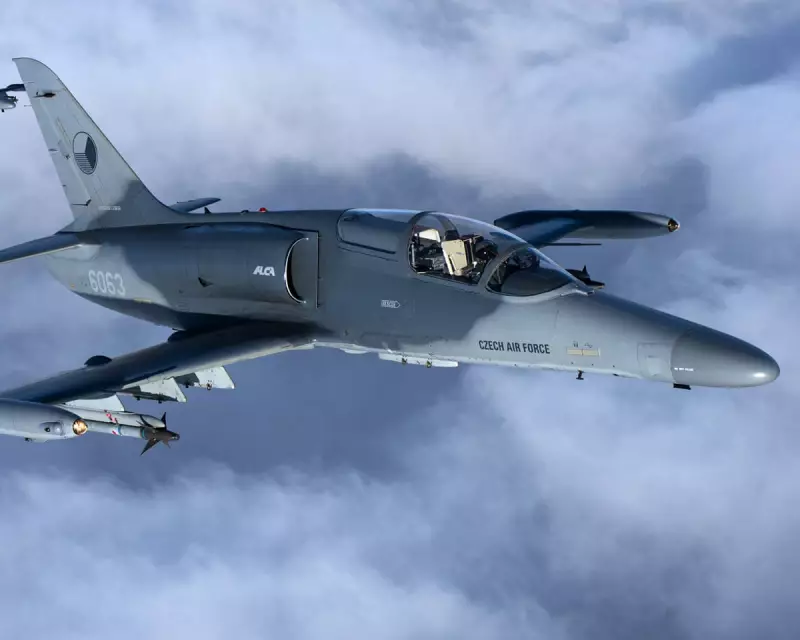
The President of the Czech Republic, Petr Pavel, has made a significant pledge to bolster Ukraine's aerial defences, promising to supply 'medium combat' aircraft specifically for hunting Russian drones. The announcement came during a meeting with Ukrainian President Volodymyr Zelenskyy in Kyiv on Friday, marking day 1,424 of the conflict.
A Strategic Boost for Ukrainian Air Defences
While not explicitly named in the public statement, the aircraft in question are almost certainly the Czech-made L-159 light attack and trainer jets. President Pavel has previously indicated these subsonic planes could be transferred to aid Ukraine's war effort. "I believe we will manage to quickly and successfully conclude this issue," Pavel stated at a joint news conference with his Ukrainian counterpart.
The Czech military currently operates a fleet of 24 L-159 aircraft, used for training and providing support to ground forces. These versatile jets can be armed with missiles and machine-gun pods, making them potentially effective against the swarms of Iranian-designed Shahed drones that Russia has used extensively to target Ukrainian energy infrastructure and cities.

The L-159 has seen combat before, notably deployed by Iraq in operations against Islamic State. Furthermore, private companies own additional fleets which are leased to the US and UK air forces for advanced combat training exercises.
Zelenskyy Highlights Critical Shortages Amid Russian Assaults
The Czech offer comes at a critical juncture, as President Zelenskyy openly conceded severe problems with Ukraine's air defence capabilities. He revealed that some Western-supplied systems had run out of ammunition during a recent wave of relentless Russian attacks, which have devastated the country's power grid.
"Until this morning we had several systems without missiles. Today I can say this openly because today I have those missiles … We received a substantial package in the morning," Zelenskyy explained. He urgently called on both European allies and the United States to dramatically increase the pace and volume of deliveries.
Beyond the fighter jets, President Pavel suggested Prague might also provide early-warning radar systems to enhance Ukraine's ability to detect incoming threats. The Czech Air Force's primary frontline fighter is the Swedish-built Saab JAS-39 Gripen, which is not part of this proposed transfer.
Broader Diplomatic and Security Maneuvers
In parallel to the military discussions, Ukraine and the United States are set to hold high-level talks in Miami on Saturday. The negotiations, confirmed by Kyiv's ambassador, will focus on long-term security guarantees and post-war economic recovery. The Ukrainian delegation is expected to include key officials like the head of the presidential office and the defence council secretary.
Zelenskyy expressed hope that a security agreement with the US could be signed as early as next week, potentially on the sidelines of the World Economic Forum in Davos. However, public opinion in Ukraine remains firmly against territorial concessions. A poll released by the Kyiv International Institute of Sociology (KIIS) indicated that 54% of Ukrainians would categorically reject withdrawing troops from the remaining parts of Donetsk region they control, even in exchange for security guarantees from Europe and the US.
The survey, conducted in early January, also found deep scepticism about the prospects for a lasting peace through current negotiations, with a majority fearing Russia would simply attack again after any ceasefire.
In a rare moment of coordination, Russia and Ukraine agreed to a localised ceasefire around the occupied Zaporizhzhia nuclear power plant on Friday. The temporary truce, facilitated by the UN's nuclear watchdog (IAEA), will allow repairs to the last remaining backup power line essential for cooling the plant's nuclear fuel.