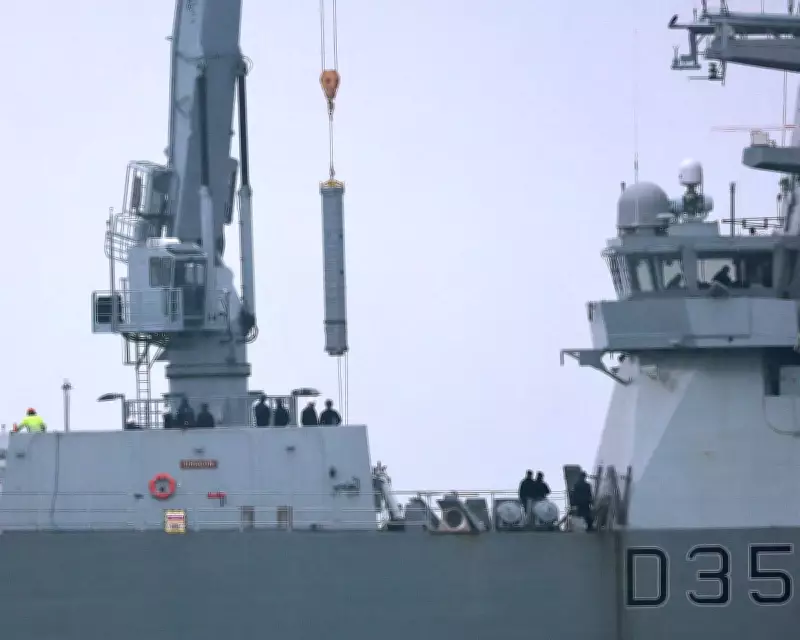
HMS Dragon Deployment to Cyprus Faces Delays Amid Criticism
Defence Secretary John Healey has confirmed that the Royal Navy destroyer HMS Dragon will set sail for the eastern Mediterranean in "the next couple of days", potentially delaying its arrival off the coast of Cyprus until after the weekend. The announcement comes amid mounting criticism over the British government's response to recent drone attacks in the region.
Preparation Efforts and Political Backlash
John Healey told the House of Commons that navy crews were working "tirelessly, 22 hours a day" to prepare the warship for deployment. He revealed that proposals to deploy HMS Dragon were discussed six days ago and formally approved approximately 36 hours after a drone struck the RAF airbase at Akrotiri on Cyprus.
The drone attack occurred during the fourth day of a joint US-Israel operation against Iran, which followed a highly visible six-week buildup of US forces in the Middle East. This prompted Iranian retaliation against ten countries within 24 hours, escalating regional tensions significantly.

International Comparisons and Domestic Criticism
Britain has faced substantial criticism from Cyprus for not acting swiftly enough to protect the country, which hosts two UK military bases. Following the drone attack, nearby villages were evacuated and non-essential personnel were removed while two additional incoming drones were successfully intercepted.
Shadow Defence Secretary James Cartlidge highlighted that France, Greece, and Spain have already deployed warships to Cyprus, accusing the Labour government of undermining Britain's international standing through delayed action. "Labour's failure to deploy the Royal Navy to the eastern Mediterranean has completely undermined our international standing," Cartlidge stated during parliamentary debates.
Defence Secretary's Response and Historical Context
In his defence, Healey pointed to what he described as Conservative governments having "hollowed out and underfunded" British forces, citing a £12 billion reduction in the defence budget and a decrease in frigate and destroyer numbers from 23 to 17 vessels. He emphasized that three of the Royal Navy's six Type 45 destroyers, equipped with advanced counter-drone systems, were theoretically available for deployment last week, though HMS Dragon required extraction from dry dock maintenance.
The sailing time from Portsmouth to Cyprus is estimated between five and seven days, meaning the destroyer may not reach its destination until after the weekend. Meanwhile, France has already deployed its Charles de Gaulle aircraft carrier to the eastern Mediterranean, with President Emmanuel Macron meeting Cyprus's President Nikos Christodoulides and Greece's Prime Minister Kyriakos Mitsotakis on Monday.
Technical Details and Regional Security Concerns
Healey provided additional details about the drone attacks, noting that the device that struck Akrotiri was small and originated from either Lebanon or Iraq, with its exact launch point still undetermined by UK experts. Cypriot sources had previously suggested the drone was launched from territory controlled by the Iran-backed Hezbollah militia.
Fragments of the attack drone, described as an Iranian Shahed type, are currently being analyzed for foreign military hardware. The UK has not confirmed social media reports suggesting the drone contained Russian components, maintaining that investigations are ongoing.
Broader Military Operations and Financial Considerations
Healey also reported that Typhoon pilots successfully intercepted two additional drones—one heading toward Bahrain and another destroyed over Jordan. The RAF continues to conduct protective missions for the United Arab Emirates as part of broader regional security efforts.
The Defence Secretary characterized the Iranian regime as "a source of evil", noting it has supplied over 60,000 drones to Russia for use against Ukraine. Since the beginning of the conflict, Iran has launched over 500 ballistic missiles and more than 2,000 drones at Israel and other Middle Eastern countries in retaliation against Western interests.

Prior to Healey's statement, Chancellor Rachel Reeves confirmed that the Treasury's strategic reserve has been made available to fund military operations in the Middle East, clarifying that budgetary constraints were not responsible for the delayed deployment of HMS Dragon.
Future Deployments and NATO Commitments
Downing Street has downplayed reports that the Prince of Wales aircraft carrier might be dispatched to the Middle East, despite indications that its readiness time has been reduced to five days. Officials hinted that the carrier is scheduled for deployment to the northern Atlantic as part of NATO commitments to patrol the Arctic region, reflecting Britain's broader strategic priorities amid ongoing global tensions.