

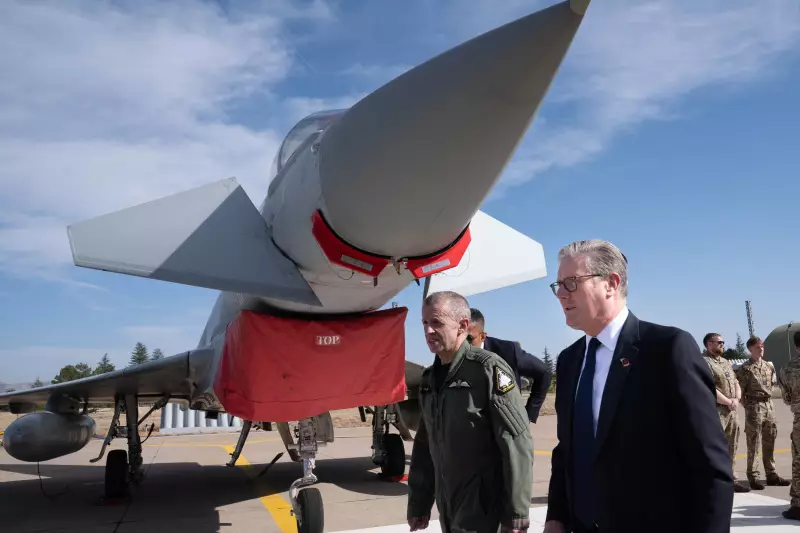
Prime Minister Keir Starmer is facing mounting pressure to significantly accelerate the UK's planned increase in defence expenditure, as opposition leaders warn that escalating global threats demand a swifter response.
Cross-Party Calls for Faster Action
During a tense Prime Minister's Questions session on Wednesday 7 January 2026, both Tory leader Kemi Badenoch and Liberal Democrat leader Ed Davey challenged the government's timeline. They urged ministers to bring forward a 2034 deadline to raise defence spending to 3% of GDP.
The calls come amid a complex backdrop of international crises, including the ongoing war in Ukraine and recent provocative actions by the US Trump administration. Davey explicitly demanded the Prime Minister increase spending "more quickly than currently planned," while Badenoch pushed for the government's "ambition" on spending targets to become a firm "commitment."

Geopolitical Crises Driving the Debate
The pressure on Starmer is directly linked to a series of global security challenges:
- Ukraine: The Prime Minister confirmed he would put a parliamentary vote on any future declaration to send British troops to protect Ukraine post-ceasefire. He stated there was "full agreement" between the US and the 'Coalition of the Willing' on providing security guarantees to Ukraine after a peace deal with Russia.
- Greenland: Recent repeated threats from President Trump to annex the semi-autonomous Danish territory, a NATO member, have prompted several European nations to declare that matters concerning Greenland must be decided independently of US intervention.
- Venezuela: The year began with a shock US operation to capture Venezuelan dictator Nicolas Maduro, with reports on Wednesday indicating US forces had seized a 'shadow' oil tanker near Venezuela now flying the Russian flag.
A full Commons statement regarding a security declaration for Ukraine, signed by Starmer, France's Emmanuel Macron, and Germany's Friedrich Merz, is expected within days.
Government's Stance and Spending Plans
In response to the criticism, Starmer defended his government's record. "I am happy that we are investing to keep our country safe," he said, describing it as "the biggest sustained increase [in defence spending] since the Cold War."
Government officials emphasised that investments were focused on "war fighting readiness," with the Prime Minister's spokesman adding, "We have confidence in British armed forces."
Currently, UK defence spending is projected to rise from 2.3% of GDP to 2.5% in 2027. However, detailed plans to reach the longer-term 3% target by 2034 have not been set out. Furthermore, the publication of the government's defence investment strategy, delayed since last summer due to internal disagreements, remains pending with no further updates provided.
The debate underscores a fundamental political clash: whether the current pace of investment matches the urgency of the threats facing the nation and its allies, setting the stage for a defining defence policy battle in the coming months.






