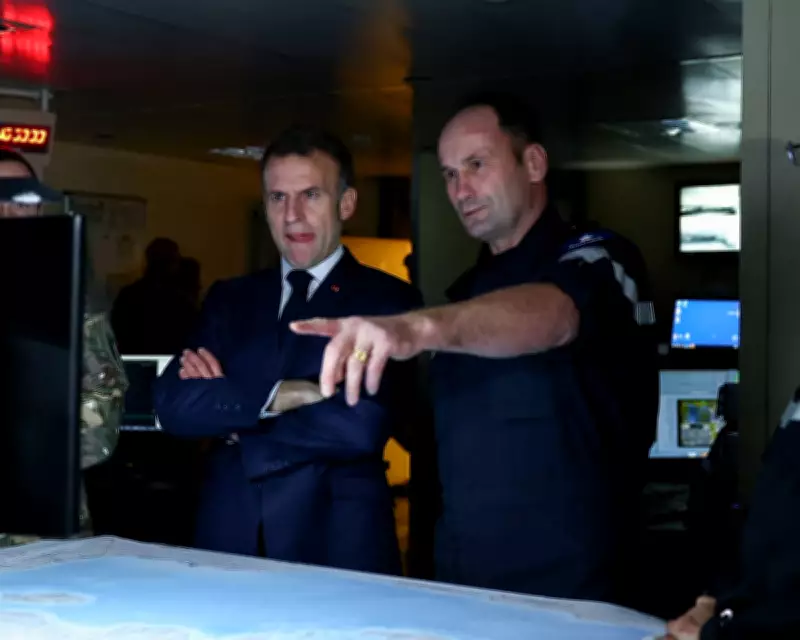
Macron Declares European Solidarity with Cyprus Following Iranian Drone Attack
French President Emmanuel Macron has made a resolute pledge that Europe will stand firmly with Cyprus, the first European Union member state to face direct consequences from the Iran war. In a powerful demonstration of unity, Macron emphasized that any assault on Cyprus constitutes an attack on the entire European continent.
Unwavering Support from European Leaders
Standing alongside Greek Prime Minister Kyriakos Mitsotakis and Cypriot officials at an airbase in Paphos, Macron articulated a clear message of collective defense. "When Cyprus is attacked, it is Europe that is attacked," he stated unequivocally. The French leader underscored that protecting Cyprus is not only crucial for the island nation and its neighbor Greece but also for France and the broader European Union.
Prime Minister Mitsotakis echoed this sentiment, asserting that Europe will not tolerate any threat to its territory, no matter how small. "We will not accept that the slightest piece of European territory, like Cyprus, be exposed to danger," he declared, reinforcing the message of continental solidarity.

The Immediate Threat and Military Response
The high-level visit followed a series of alarming incidents just one week prior:
- A Shahed drone crashed into a hangar at RAF Akrotiri, creating significant damage to a structure reportedly housing US U-2 reconnaissance aircraft.
- Two additional Iranian-made combat drones were intercepted by British fighter jets off the coast of Cyprus.
Cypriot Foreign Minister Constantinos Kombos confirmed that all three attacks originated from Lebanon, approximately 150 miles east of the island. In response to Cyprus's request for military assistance, European nations have mobilized substantial forces:
- France deployed air defense systems, a frigate, and the nuclear-powered aircraft carrier Charles de Gaulle.
- Greece dispatched four F-16 fighter jets now stationed in Paphos and two frigates, including the flagship Kimon.
- Italy, Spain, the Netherlands, and Britain have committed warships and aerial assets to establish a protective perimeter around Cyprus.
The United Kingdom has reinforced its military presence with Royal Navy Wildcat helicopters capable of neutralizing aerial threats and F-35 fighter jets to safeguard British sovereign bases on the island.
Strategic Implications and Regional Stability
Beyond immediate defense measures, Macron announced plans for a "purely defensive, purely support mission" to reopen the Strait of Hormuz once the most intense phase of the conflict subsides. This vital maritime corridor sees approximately 20 million barrels of oil daily—equivalent to one-fifth of global seaborne crude supply—with Greek tankers playing a dominant role in transportation.
"It is essential for international trade, but also for the flow of gas and oil, which must be able to leave this region once again," Macron emphasized, highlighting the economic stakes for Europe and global markets.
European Unity in a Time of Crisis
These military deployments occur during a period of significant strain in transatlantic relations, yet they demonstrate Europe's determination to defend its frontiers. Cypriot President Nikos Christodoulides noted the unprecedented nature of the European response, stating that his nation's security has become a collective responsibility of the EU.
Policy analyst Cleopatra Kitti of the Athens-based think tank Eliamep observed that Macron's visit transcends symbolic politics. "This is about Europe making her presence felt in the region when there are so many moving parts, so many unknowns," she remarked, pointing to the complex geopolitical landscape.
As the US-led offensive enters its tenth day with little optimism for a swift resolution, European leaders have signaled their readiness to protect vulnerable member states and assert continental sovereignty in an increasingly volatile Middle East.