

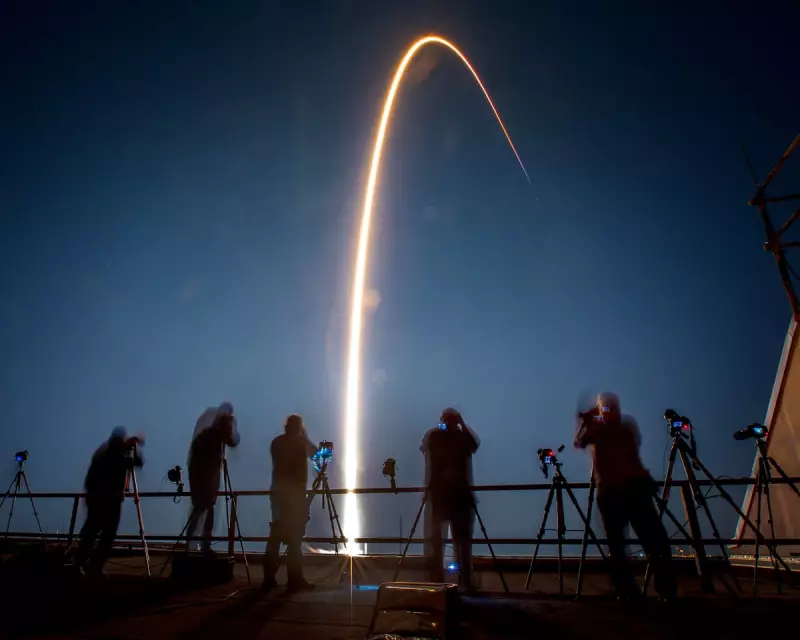
A fresh and fiercely competitive chapter in space exploration is unfolding, with the lunar surface becoming the latest arena for 21st-century geopolitical rivalry. Unlike the Cold War contest for prestige, the new race, reigniting in earnest by 2026, is fundamentally about securing valuable resources and establishing strategic dominance beyond Earth.
The Scramble for Lunar Real Estate
At the heart of this new contest is the Moon's south pole, a region coveted for its "peaks of eternal light" for solar power and suspected ice deposits hidden within permanently shadowed craters. These resources are seen as critical for sustaining long-term human presence and potentially fueling a post-terrestrial economy. The United States, alongside commercial partners, and a bloc led by China with Russia, are now on parallel tracks to establish a foothold.
This commercial push is being accelerated by policy. The Artemis Accords, championed by Washington and signed by over 40 nations, envision extending Earth-like ownership structures into space, a framework enthusiastically backed by private titans like Elon Musk and Jeff Bezos. In a significant shift, state support for NASA is being scaled back, aiming to make the private sector the primary engine of exploration.

Conversely, the International Lunar Research Station, a China-Russia collaboration with other global partners, presents a state-led model. It claims compliance with international rules by operating under a collaborative consortium rather than a single nation's control, positioning itself as an alternative to an American-dominated system.
Nuclear Power and the Drive for Permanent Bases
The competition is moving beyond rhetoric into concrete engineering. A key battleground is the development of reliable energy for the Moon's two-week-long night. Both the US and the China-Russia alliance are actively funding designs for small nuclear fission reactors to power permanent human colonies.
NASA aims to deploy such a reactor within the next five years, while China and Russia target operational capability by 2035. This technology is not novel, but its lunar application is a critical stepping stone. The nation that masters reliable off-world nuclear power could gain a decisive advantage, not just for the Moon but for future missions to Mars.
Escaping Earth's Limits or Exporting Its Problems?
The drive to leave Earth is often framed as innate human exploration. However, a more pressing catalyst may be planetary overshoot—humanity currently uses natural resources 1.7 times faster than the planet can regenerate them. Faced with this, Silicon Valley's techno-optimists increasingly favour the third option: moving energy-intensive processes off-world.
Initiatives like Google's research into orbital data centres, powered by continuous sunlight, highlight a startling admission that Earth-based digital infrastructure is approaching ecological and political limits. This pragmatic search for new energy and computing capacity risks launching a new phase of extraction, simply shifting resource depletion to a new frontier.
This real-world narrative echoes science fiction warnings, such as Kim Stanley Robinson's Red Mars, which cautioned that humanity would export its old political and environmental conflicts to new worlds. Today, space law is being shaped to allow appropriation under the banner of peaceful commercial activity, with the US's 2015 Space Act permitting asteroid mining. The danger is that the logic of resource exploitation used to justify lunar travel subtly inverts the core problem: instead of solving ecological overshoot on Earth, it becomes a licence to expand it into the solar system.
The new space race, therefore, presents a profound dilemma. It offers the potential for scientific advancement and a possible outlet for human enterprise. Yet, without robust international governance focused on sustainability and cooperation, it threatens to replicate the very patterns of competition and resource rivalry that have plagued our home planet. The question remains: can we venture into the cosmos without taking our worst instincts with us?






