

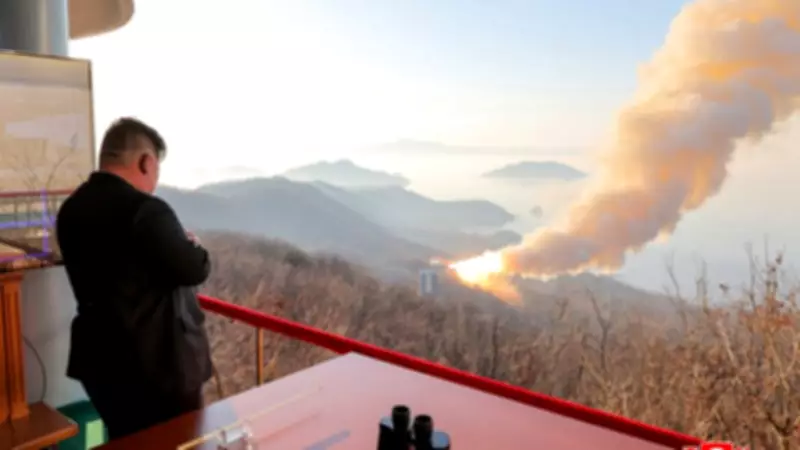
North Korea has conducted a significant engine test for a missile capable of striking the US mainland, as reported by state media. This development follows a recent speech by leader Kim Jong Un, where he vowed to irreversibly solidify his country's status as a nuclear power.
Engine Test Details and Strategic Implications
Kim Jong Un observed a ground jet test of a newly upgraded high-thrust solid-fuel engine, according to the Korean Central News Agency (KCNA). The engine, utilizing composite carbon fibre materials, achieved a maximum thrust of 2,500 kilotons, marking an increase from the 1,971 kilotons reported in a similar test conducted in September.
This enhancement in engine power is widely interpreted by observers as part of efforts to equip missiles with multiple warheads, thereby increasing the likelihood of penetrating US defence systems. The test is a key component of North Korea's five-year military escalation programme, which aims to upgrade strategic strike means, specifically referring to nuclear-capable intercontinental ballistic missiles (ICBMs) targeting the continental United States.

Kim Jong Un's Statements and Regional Context
In his address to North Korea's parliament, Kim Jong Un accused the United States of engaging in global "state terrorism and aggression," a remark perceived as alluding to the ongoing conflict in the Middle East. He emphasized that the engine test holds "great significance in putting the country's strategic military muscle on the highest level," underscoring the regime's commitment to advancing its military capabilities.
Over recent years, North Korea has test-fired a variety of ICBMs with the potential range to reach the US mainland. Notably, missiles employing solid propellants, such as the one tested, are more difficult to detect prior to launch compared to older liquid-fuel models, which require pre-launch fuelling and have limited longevity.
Technological Challenges and Expert Opinions
While North Korea has made substantial progress in its missile programmes, some foreign experts highlight persistent technological hurdles. Key challenges include ensuring that warheads can survive atmospheric reentry to become fully functional ICBMs. However, other analysts contest this assessment, pointing to the extensive time and resources the nation has dedicated to its nuclear and missile development initiatives.
The push to expand North Korea's nuclear arsenal has intensified since the collapse of high-stakes diplomacy with former US President Donald Trump in 2019. During a ruling Workers' Party congress in February, Kim Jong Un indicated a willingness to engage in discussions with the US president but insisted that Washington must abandon demands for North Korea's nuclear disarmament as a precondition for talks.
This engine test represents a critical step in North Korea's ongoing efforts to modernize its military infrastructure and assert its position as a formidable nuclear power on the global stage.






