

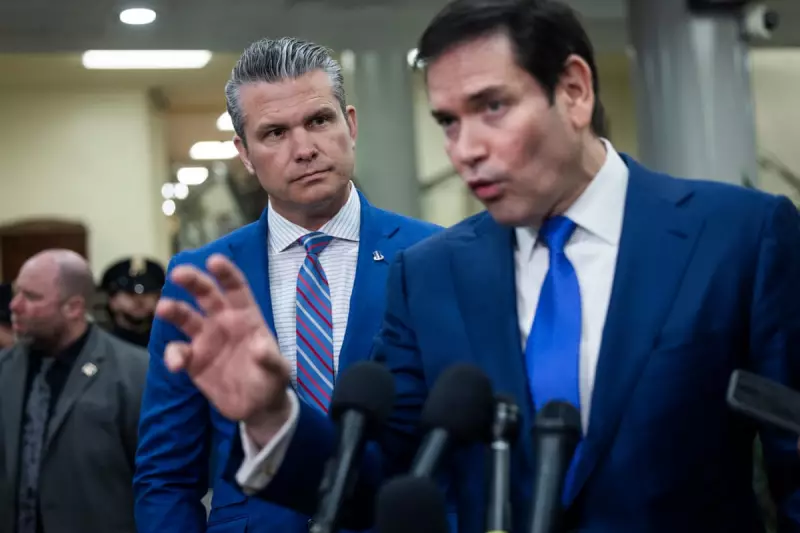
The Trump administration's most senior figures faced the entire United States Senate today to justify a dramatic military operation that saw Venezuelan leader Nicolás Maduro forcibly removed from his Caracas home and taken to a New York jail.
A High-Stakes Capitol Hill Briefing
In an unprecedented session on Tuesday, 7th January 2026, all 100 senators received a confidential briefing on Operation Absolute Resolve. The officials leading the presentation were Secretary of State Marco Rubio, Defense Secretary Pete Hegseth, Attorney General Pam Bondi, CIA Director John Ratcliffe, and General Dan Caine, the Chair of the Joint Chiefs of Staff.
This marked the first time the full Senate heard detailed accounts of the raid, which occurred in the early hours of Saturday, 3rd January. US special forces, reportedly from Delta Force, captured Maduro and his wife, Cilia Flores, from their residence and transported them via the USS Iwo Jima to the United States. Maduro has since pleaded not guilty in a New York federal court to charges including narco-terrorism conspiracy.

Oil Plans and Political Firestorm
Emerging from the briefing, Marco Rubio outlined a three-phase plan for Venezuela centred on its vast oil reserves. He stated the US intended to seize and sell between 30 and 50 million barrels of Venezuelan oil at market rates, moving away from previous discounted deals.
The operation has ignited a fierce partisan divide. Republicans have rallied behind President Trump's framing of the mission as a lawful action against an indicted criminal. "We took out an illegitimate president," said Republican Senator Markwayne Mullin, arguing no regime change occurred as Maduro was never duly elected.
Democrats, however, have condemned it as an illegal act of war. Senator Chris Murphy expressed incredulity, telling reporters, "They are talking about stealing Venezuelan oil at gunpoint... This is an insane plan." Senate Minority Leader Chuck Schumer echoed concerns, demanding answers on the operation's duration, cost, and strategic guardrails.
Public Unease and International Fallout
The political split in Washington mirrors broader American public opinion. Recent polls indicate significant unease:
- Over 60% believe congressional approval should have been required.
- Roughly three-quarters are concerned the US will become overly entangled in Venezuela.
- Approval ratings for the operation are deeply divided along partisan lines.
Internationally, condemnation has been swift. Nations including Brazil, China, France, Russia, and Spain have denounced the raid. At an urgent UN Security Council meeting, Russian and Chinese representatives demanded Maduro's immediate release, while the US defended its actions as targeted law enforcement.
Meanwhile, the administration shows no sign of relenting. The US Coast Guard has seized two Venezuela-linked oil tankers, and a naval fleet remains positioned off the Venezuelan coast. Defense Secretary Hegseth affirmed, "Our military is prepared to continue this... we are an administration of action."
With the Maduro government's apparatus still largely intact and Vice President Delcy Rodríguez in a provisional leadership role, the path forward for Venezuela remains highly uncertain, leaving allies and critics alike questioning the long-term strategy.






