

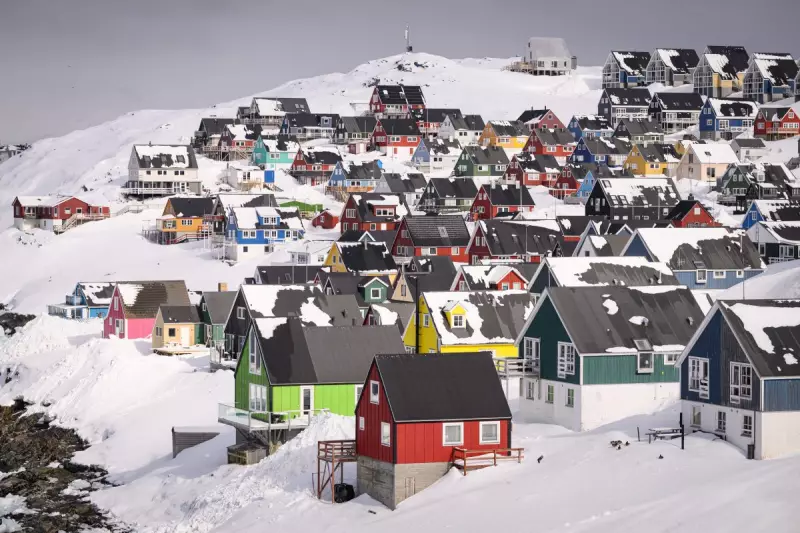
The prospect of a US military invasion of Greenland, floated during the Trump era, has been met with alarm and ridicule in equal measure. Yet, beneath the sensational headlines lies a far more plausible and significant reality: a potential financial and industrial takeover driven by Wall Street, not the Pentagon.
The Strategic Prize: Why Greenland Matters
Greenland's importance to American strategic interests is undeniable. As its ice shelf melts at a staggering rate of 270 billion tonnes per year, new Arctic sea lanes are opening. The island controls the northern end of the crucial Greenland-Iceland-UK Gap, a vital corridor for NATO submarine surveillance and resupply routes to Europe.
Furthermore, the increasingly navigable Northwest Passage skirts its coast. Former US Secretary of State Mike Pompeo once labelled these emerging Arctic routes the "21st-century Suez and Panama Canals." This geostrategic value is already acknowledged with the presence of the massive Pituffik Space Base, a key part of US air defence and missile early-warning systems.

Three Reasons an Invasion is Nonsense
Despite the rhetoric, a military invasion is virtually unthinkable for three compelling reasons.
First, the United States is already the dominant military power on the island. The Pituffik base, recently approved for a $4 billion upgrade programme, features a 10,000-foot runway and the world's northernmost deepwater port. Any expansion could be achieved through agreement, not aggression, under the existing 1951 treaty with Denmark.
Second, the terrain is profoundly inhospitable. Eighty per cent of Greenland is buried under an ice sheet averaging a mile thick. With a population of just 57,000, limited infrastructure, and only one 100-mile road, there is simply nothing to invade.
Third, and most crucially, America has nothing to gain militarily and everything to lose diplomatically. However, it has a tremendous amount to gain through peaceful financial and industrial cooperation.
The Real Battle: A Race for Critical Minerals
The true allure of Greenland is not ice, but what lies beneath. The global race for the rare earth elements and critical minerals essential for batteries, smartphones, electric vehicles, and advanced computing has placed the island squarely in the crosshairs of economic superpowers.
Sites like the Kvanefjeld mine in the Ilimaussaq Intrusion hold concentrated quantities of roughly 30 of the 50 minerals critical to modern technology, accounting for an estimated 10 per cent of global rare earth reserves. For the US, securing a reliable supply is a matter of urgent national security, particularly to counter Chinese dominance in semiconductor production and reduce strategic dependency.
China has already demonstrated intense interest, proposing multi-billion dollar investments in mining and infrastructure that would have brought thousands of Chinese workers to Greenland. These plans were blocked by Denmark and the US, highlighting the high-stakes geopolitical game being played.
A Compact for the Future, Not a Conquest
Therefore, the path forward is not military but financial. An outright purchase may be politically toxic, but other models exist. A Compact of Free Association, similar to US agreements with Pacific nations, could provide a framework for deep economic and security cooperation.
Such a deal would unlock trillions of dollars in Wall Street investment for mineral extraction and infrastructure, far surpassing Greenland's current reliance on Denmark's annual block grant of 3.9 billion kroner (about $560 million). Managed wisely, this could bring prosperity to Greenland's predominantly Inuit population while securing vital resources for the West.
The challenge for Greenland is to harness its vast resource wealth without sacrificing its fragile culture and ecology. The coming years could forge a global model for sustainable extraction and indigenous self-determination. America, China, and Russia may all want a piece of Greenland, but the island may need their capital and expertise just as much to secure its own future.






