

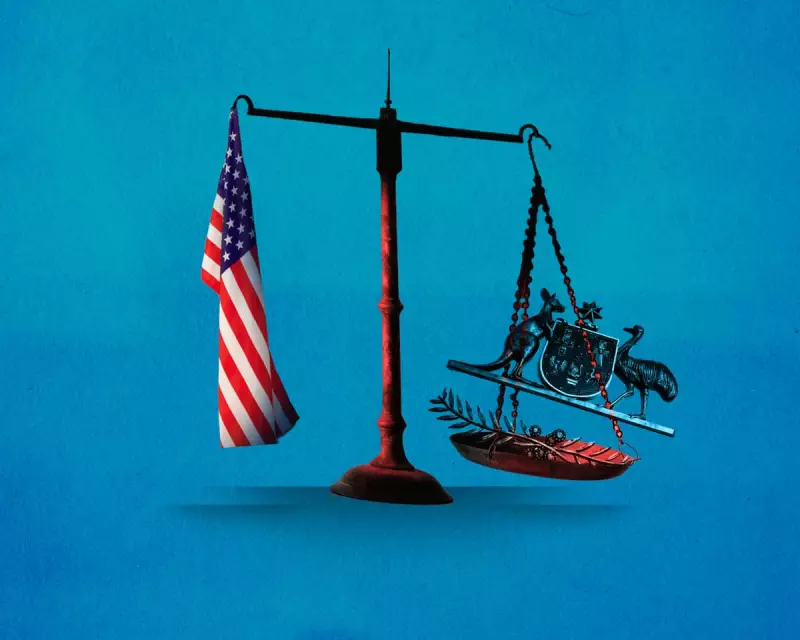
The strategic partnership between Australia and the United States is experiencing a crisis of confidence unparalleled since the Second World War, according to analysts. Public faith in the alliance has evaporated during Donald Trump's more radical second presidency, raising fundamental questions about its future viability.
A Monument Under Scrutiny
High above Canberra, the Australian-American Memorial—a stylised eagle on an 80-metre column—symbolises decades of security cooperation. Erected to commemorate US defence of Australia during WWII, some now interpret it differently: as a symbol of a dominant power overseeing a subordinate nation.
For over seventy years, the alliance has been a cornerstone of Australian defence policy. Yet its endurance relies on a social licence, a belief among Australians that it serves the national interest. Foreign Minister Penny Wong has cautioned against politicising the relationship, but recent polling suggests a profound shift in public sentiment.

Collapsing Confidence in a Capricious Superpower
Australian confidence in its "great and powerful friend" has disintegrated. A Lowy Institute poll from June 2025 found that 72% of Australians have little or no confidence in President Trump "to do the right thing". A separate YouGov poll for the Australia Institute revealed only 8% believe Australia shares values with modern America, with a plurality viewing the US as an unreliable ally.
Trump's actions have fuelled this disillusionment. Beyond the brazen intervention in Venezuela, he has openly contemplated seizing Greenland from NATO ally Denmark and threatened Cuba. This week, he appeared ready to intervene in Iran's domestic unrest. Former Labor foreign ministers Gareth Evans and Bob Carr have publicly questioned the alliance's future, with Evans labelling Trump's America as having "zero respect for international law, morality and the interests of its allies".
No Return to 'Normal': A Lasting Legacy
Michael Fullilove, Executive Director of the Lowy Institute, argues that while Australians dislike Trump, broader support for the alliance remains robust, with eight in ten viewing it as important for security. However, he warns there will be no simple "snap back" to the pre-Trump liberal international order.
"The liberal international order has been replaced by something illiberal, nationalistic and disorderly," Fullilove stated. "The leader of the free world doesn’t believe in the free world, and doesn’t want to lead it." He advocates for a three-pronged Australian response: greater self-reliance (including via AUKUS submarines), stronger regional partnerships, and continued efforts to keep the US engaged in the Indo-Pacific.
A Generational Challenge and a Shaky Foundation
Professor Bec Strating, Director of the La Trobe Centre for Global Security, notes that alliances rely on trust and demonstrated resolve. While Australia provides significant value through assets like the Pine Gap intelligence base and RAAF Tindal, US contempt for NATO allies offers a cautionary tale.
Strating cautions against viewing Trump as a mere anomaly, stating his re-election "solidified the idea that there is no real going back to normal for the US now." A generational shift may further strain ties, as younger Australians, deeply concerned about climate change, find a US administration promoting "drill, baby, drill" increasingly unpalatable.
Emma Shortis of the Australia Institute argues the alliance is "on really shaky ground." She points to the Trump administration's 2024 National Security Strategy, which mentions Australia only three times and hints at interfering in allies' domestic politics to support right-wing parties. Shortis warns that the AUKUS submarine deal risks locking Australia into American military adventurism and eroding sovereign decision-making.
The fundamental question for Australia, allied to a capricious and increasingly illiberal America, is one it hasn't faced for seven decades: how to ensure security in a world where the era of unchallenged US dominance is demonstrably ending. The house of cards upon which the alliance is built is being tested, and its foundations may not hold.






