

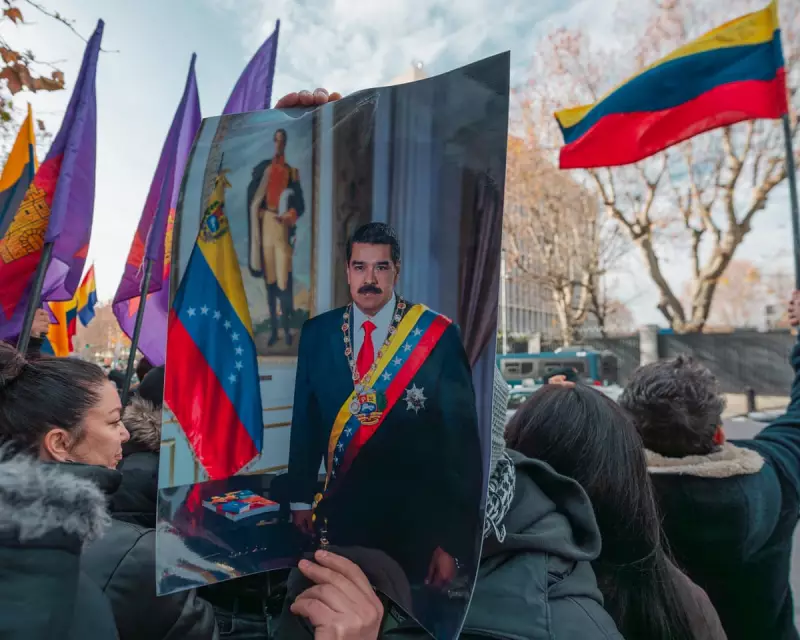
A significant protest unfolded outside the US embassy in Madrid on 4 January 2026, as demonstrators rallied against the capture of Venezuelan leader Nicolás Maduro. The scene, captured by photographer Olmo Blanco, symbolises the deep divisions triggered by a recent audacious American military operation. While Spain joined Latin American nations in condemnation, the broader European response has been marked by a troubling and strategically foolish ambiguity.
A Pattern of Complicity and Hesitation
European capitals have once again faltered in defending the international legal order they claim to champion. Following muted reactions to conflicts in Gaza and Iran, most EU governments have fudged their response to the US-led regime change in Venezuela. With few exceptions like Spain, the Netherlands, and Norway, leaders have struggled to reconcile their disdain for Maduro's illegitimate dictatorship with the blatant illegality of the foreign military attack that toppled him.
French President Emmanuel Macron, UK Prime Minister Keir Starmer, and European Commission President Ursula von der Leyen made passing reference to international law while stressing they shed no tears for Maduro's fall. German Chancellor Friedrich Merz perplexingly suggested examining the operation's legality, and Italy's Trump-friendly Prime Minister Giorgia Meloni went further, labelling the intervention "legitimate" self-defence against narco-trafficking.

The Flawed Security Rationales for Silence
Analysts point to three shaky security justifications for Europe's tepid stance. The first is fear of provoking Donald Trump, potentially leading to a US troop withdrawal from Europe or the abandonment of Ukraine. This scenario, however, is already in motion. Minor withdrawals from Romania have begun, with signals of a larger pullout next year. Regarding Ukraine, Trump has repeatedly undermined Kyiv, humiliating President Zelenskyy, suspending aid, and co-authoring a capitulation plan with Russia. European belief that criticising the Venezuela coup would endanger security guarantees for Ukraine is described as delusional.
The second rationale involves Greenland. Trump's "Donroe doctrine"—a rebooted Monroe doctrine—asserts US hegemony in the Western Hemisphere, a zone he now defines as including Western Europe and Denmark's autonomous region of Greenland. European silence over Venezuela is seen as an attempt to appease Trump and deter a grab for Greenland. This strategy of submission, however, only invites further colonial treatment.
The third, least noble reason, ties to Venezuela's alliance with Putin's Russia. Maduro's fall could boost Venezuelan oil production, lowering global prices and starving Putin's war machine. While damaging to Russia, this does not justify ignoring a fundamental breach of sovereignty.
A Dangerous Precedent for European Security
The core argument is that Europe's ambiguity is not merely unethical but strategically stupid. The illegal overthrow of a regime, however odious, by a foreign power to establish a quasi-colonial protectorate violates the very principles of sovereignty upon which European security is built. It normalises the law of the jungle championed by autocrats like Vladimir Putin.
While Putin has pursued such spheres of influence in Ukraine, Georgia, and Moldova independently, Trump's actions in Venezuela provide a powerful green light. By silently condoning this vision, European leaders are undermining the rules-based order that protects them, ultimately acting against their own long-term security interests. Their failure to call out this gross violation sets a perilous precedent that will haunt the continent.






