

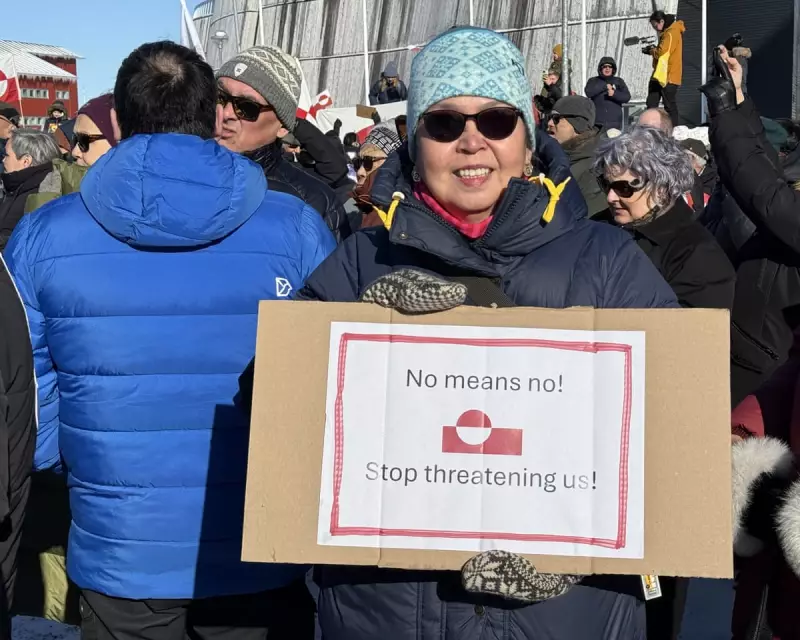
Political leaders in Greenland have issued a powerful and unified rebuke to former US President Donald Trump, declaring their people "don't want to be Americans" after he renewed threats to acquire the mineral-rich Arctic island.
A United Front Against Annexation
The leaders of five parties in Greenland's parliament, the Inatsisartut, released a joint statement on Friday night. This swift response came just hours after Trump told reporters the US would act in Greenland "whether they like it or not," suggesting occupation could happen "the nice way or the more difficult way." The group, which included current Prime Minister Jens-Frederik Nielsen and former premier Múte B. Egede, stressed the fundamental right to self-determination.
"We don't want to be Americans, we don't want to be Danish, we want to be Greenlanders," the statement declared. It emphasised that the future of the vast, self-governing Danish territory must be decided solely by its own inhabitants, free from external pressure or interference.

Trump's Security Justification and NATO Tensions
Trump's comments were made during a meeting with oil and gas executives at the White House, where he framed Greenland as crucial for US national security, claiming failure to act would allow Russian or Chinese occupation. The White House confirmed this week that Trump is "actively" discussing a potential offer with his national security team, reviving a 2019 bid to buy the island that was firmly rejected.
The threats have sent shockwaves through the NATO alliance, of which Denmark is a founding member. Danish Prime Minister Mette Frederiksen has warned that a US invasion of Greenland would mean the end of NATO and post-World War II security. She asserted the US has "no right to annex any of the three countries in the Danish kingdom." When pressed on whether preserving NATO or acquiring Greenland was his priority, Trump previously told the New York Times, "It may be a choice."
Public Opinion and Military Reality
The political stance in Greenland reflects overwhelming public sentiment. A 2025 poll indicated 85% of Greenlanders reject becoming part of the United States. Similarly, only 7% of Americans support a military invasion of the territory. The US already maintains the Thule Air Base in northwestern Greenland under existing agreements with Denmark, which technically allow for troop increases.
However, Trump dismissed the notion of a lease, stating, "Countries have to have ownership and you defend ownership, you don't defend leases." Meanwhile, senior US General Alexus Grynkewich, head of NATO forces in Europe, sought to downplay the crisis, stating the alliance was "far from being in a crisis" and remained ready to defend all member territory.
Local figures have also challenged Trump's narrative. Jess Berthelsen, chair of Greenland's national trade union confederation SIK, told the Guardian that people "can't see, recognise, or understand" the alleged presence of Russian and Chinese ships in Greenlandic waters, which the former president has cited as justification.






