

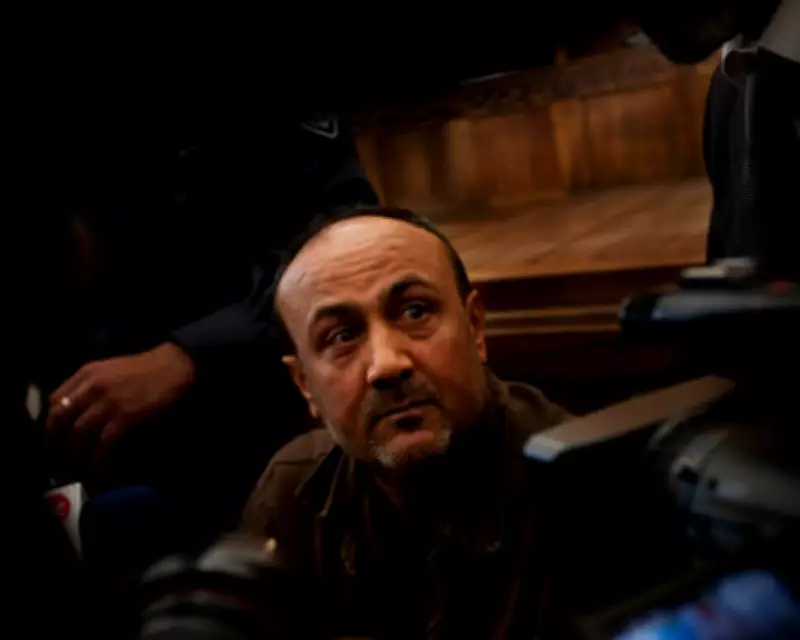
Son of 'Palestine's Mandela' Demands UK Action on Father's Release
The son of Marwan Barghouti, the Palestinian political prisoner often compared to Nelson Mandela, has issued a direct appeal to the British government to place his father's freedom at the center of efforts for Palestinian democratic renewal. Arab Barghouti cautioned that the UK's recent recognition of a Palestinian state could become merely a symbolic gesture in history books unless it is accompanied by concrete diplomatic action to secure his father's release from an Israeli jail.
False Hopes and Democratic Stagnation
"Simply declaring support for a two-state solution without taking tangible steps is exacerbating the problem by offering the Palestinian people false hopes," Arab Barghouti stated emphatically. He highlighted the dysfunctional state of current Palestinian politics, which he argued can only be transformed through democratic renewal and new leadership that genuinely represents the populace. "We have not held elections for two decades," he noted, underscoring the political vacuum.
Barghouti further insisted that no legal barrier exists to prevent his father from standing in the upcoming Palestinian parliamentary elections scheduled for November 1, even if Israeli authorities continue to detain him. This point is critical as Marwan Barghouti remains the most popular candidate to succeed Mahmoud Abbas as president of the Palestinian Authority, according to successive opinion polls.

Cross-Party Campaign and International Pressure
A cross-party group of British MPs has been actively campaigning for Barghouti's release, portraying him as a unifying figure capable of accelerating progress toward a two-state solution—a peaceful political outcome he has championed from within prison walls. Despite this advocacy, the Foreign Office has thus far declined to endorse calls for his freedom.
Labour MPs have expressed growing frustration over the UK government's passive stance following its recognition of Palestine, contrasting it with the more proactive approaches of France and Spain. When questioned about supporting Barghouti's release, the Foreign Office responded in writing that it backs the International Committee of the Red Cross's access to Palestinian prisoners, stopping short of direct advocacy.
Legal Controversies and Prison Conditions
Marwan Barghouti, a senior member of the Fatah party's central committee, has been imprisoned for 22 years after receiving multiple life sentences in September 2003 for five murders. A comprehensive Inter-Parliamentary Union inquiry concluded that his trial failed to meet international standards of fairness. During the second intifada, Barghouti stated his opposition to targeting civilians inside Israel while defending the right to resist occupation.
Israel has released over 500 Palestinians serving life sentences in the past 15 years but has consistently excluded Barghouti. His son revealed that since the October 7 attack on Israel, his father has been held in solitary confinement and subjected to multiple assaults, most recently in October, resulting in broken ribs. "If that is not an invitation to speak out against violations of international law, I don't know what is," Arab Barghouti declared.
Path to Political Settlement
Arab Barghouti argued that his father, if freed, would be uniquely positioned to garner Palestinian support for any agreement, representing the most viable route to a non-violent resolution. "The reason he is not being released is because the Israeli government does not want a legitimate Palestinian leader, because it does not want a two-state solution," he asserted.
He expressed disappointment in the lack of political courage at the highest levels of British politics, stating, "We have not yet had brave enough British politicians when it comes to the highest level of politics." The Barghouti campaign has been working to address concerns among some MPs regarding his father's conviction, emphasizing the flaws in the Israeli judicial process as documented by the IPU inquiry.

Simon Henderson, author of the 2003 IPU report, informed a Westminster meeting that his investigation—conducted after full discussions with the Israeli attorney general—found that of 96 witnesses, only 21 could testify to Barghouti's involvement, yet none did so, with 12 explicitly exonerating him. Israel maintains that Barghouti helped establish Fatah's armed wing during the second intifada and was claimed as a leader by the al-Aqsa Martyrs Brigade.





