

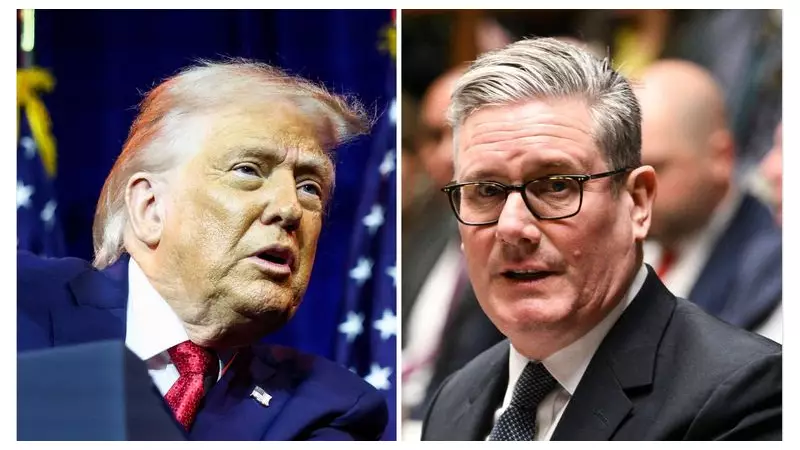
Prime Minister Sir Keir Starmer has declared that "more needs to be done to protect" the vulnerable Arctic region, following a second high-stakes phone call with US President Donald Trump in as many days. The leaders focused on the pressing "need to deter an increasingly aggressive Russia in the High North," according to a statement from Downing Street.
Diplomatic Flurry Over Euro-Atlantic Security
The urgent discussions on Thursday 8 January 2026 come amidst a whirlwind of diplomatic activity triggered by President Trump's overt ambitions regarding Greenland. The US leader, who recently oversaw the capture of Venezuela's Nicolás Maduro, has repeatedly stated that the United States needs the vast Arctic island, calling it "very important for the national security of the United States, Europe, and other parts of the free world."
US officials have not ruled out using "military means" to acquire the semi-autonomous Danish territory, a move that has sent shockwaves through NATO. Danish Prime Minister Mette Frederiksen has warned that the alliance itself would be under threat if the US invaded.

In their initial call on Wednesday, described by sources as "positive" and "friendly," Sir Keir reiterated the UK's firm position that decisions about Greenland's future must rest solely with its people and Denmark. However, the follow-up conversation on Thursday pivoted squarely to the broader strategic challenge of countering Moscow's ambitions in the Arctic.
UK Reaffirms Alliances Amid Rising Tensions
The Prime Minister's diplomatic offensive extended beyond Washington. He also spoke with NATO Secretary General Mark Rutte, with both agreeing that more action was required to deter Russia in the High North and welcoming talks on how allies could better protect the region.
In a separate call with Danish PM Mette Frederiksen, Sir Keir firmly stated that Britain "stood" with Denmark in defence of Greenland. The leaders also discussed the ongoing conflict in Ukraine, underscoring the interconnected nature of security threats.
This stance follows a joint statement earlier this week from the UK and European allies, widely interpreted as a message to Washington, vowing they would "not stop defending" Greenland's territorial integrity. Sir Keir has also faced domestic pressure to rule out any potential US use of UK military bases to support action against Greenland.
US Vice President Ramps Up Rhetoric
The situation was further inflamed by comments from US Vice President JD Vance at the White House on Thursday. He asserted that President Trump's words on Greenland should be taken seriously, stating, "Greenland is really important not just to America's missile defence, but to the world's missile defence."
Vance issued a stark warning to European allies: "So what we're asking our European friends to do is to take the security of that landmass more seriously, because if they're not, the United States is going to have to do something about it."
Behind the scenes, a frantic diplomatic effort is underway. Denmark's ambassador to the US, Jesper Moller Sorensen, and Greenland's chief representative in Washington, Jacob Isbosethsen, met with White House National Security Council officials on Thursday to seek clarity on US intentions. While military action remains one option, US officials have also suggested the purchase of the territory is a possibility, with Secretary of State Marco Rubio scheduled to meet Danish officials in Washington next week.
The Prime Minister's engagement follows criticism from Conservative leader Kemi Badenoch for not speaking to President Trump sooner after US forces seized Maduro and two oil tankers—an operation that involved UK forces in the North Atlantic. As the Arctic emerges as a new flashpoint in East-West relations, the UK is navigating a delicate path between its historic "special relationship" with the US and its commitments to European allies and NATO principles.






