

Prime Minister Keir Starmer's attempt to project calm statesmanship in the face of Donald Trump's escalating threats against Greenland has resulted in a significant diplomatic failure. The Labour leader's strategy, predicated on reasoned dialogue with the US President, appears to have badly misjudged the reality of the situation.
A Press Conference That Offered Little Reassurance
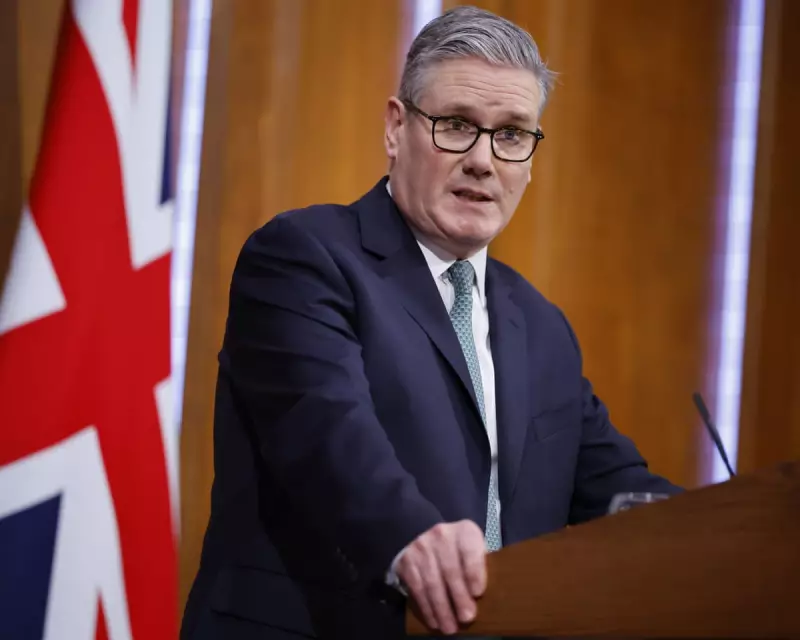
Addressing the media from Downing Street on Monday morning, Starmer adopted his most grave barrister's tone. The planned domestic relaunch of his government's agenda, already derailed once by Trump's intervention in Venezuela, was hijacked for a second time. The Prime Minister was forced to pivot to an emergency statement concerning Trump's threats to impose tariffs on the UK and seven EU nations over their troop deployments to Greenland, and his subsequent musings about seizing the island.
Starmer firmly stated that Greenland's sovereignty rested solely with Greenland and Denmark. He advocated for "calm diplomacy" and warned against overreaction, implicitly criticising French President Emmanuel Macron's threat of retaliatory tariffs. His proposed solution was simple: sit down with Trump, talk things through man-to-man, and allow reason to prevail.

The Fatal Flaw: Assuming a Sentient Counterpart
The core failure of Starmer's approach, however, was its foundation on a critical category error. His entire strategy presupposed that Donald Trump is a sentient being capable of responding to reason and acting like a proper grown-up. As the past weeks have brutally illustrated, this is not the reality the international community is dealing with.
Trump operates as a bully who relishes wielding power over weaker entities. His interest in Greenland stems not from strategic necessity but from a whim—because he fancies it and because he can. The chaos he sows, and the desperate scrambling of allies like Starmer to coordinate a response, is a feature, not a bug. He enjoys the spectacle of weakness and covets the historical legacy of a president who expanded US territory.
When pressed by journalists on a Plan B, Starmer had little to offer beyond the hope that the President would see sense. He expressed a belief that Trump was not seriously planning a forcible annexation, despite the President's own explicit statements to the contrary should Denmark refuse to sell.
Consequences of a World Without Consequences
Starmer's world is one where boats are not rocked and alliances are maintained at all costs. Trump's world, conversely, is one devoid of meaningful consequences. Each humiliation is met only with an invitation for further humiliation. The Prime Minister's major bargaining chip—a coveted state visit—was offered too early and too cheaply.
The implications are stark. If Trump can threaten Greenland with impunity, what is to stop him from turning his attention elsewhere? The scenario of him coveting Scotland, where he already owns golf courses, suddenly feels less far-fetched. Starmer's response, based on current form, would likely be more expressions of disappointment and pleas for maintaining the special relationship.
This episode severely undermines Starmer's carefully cultivated reputation as an effective Trump wrangler. While he correctly identifies that a trade war and a breakdown in the security alliance would be disastrous for the UK, his strategy to prevent it is in tatters. The spectacle leaves Presidents Putin and Xi Jinping watching the Western alliance fracture from within, gifted an unexpected licence for their own ambitions in Ukraine and Taiwan.
The Prime Minister may yet secure a clarifying meeting in Davos, but few would bet on a change of heart from the Oval Office. For now, Starmer's calm diplomacy has resulted in yet another profound humiliation, revealing a dangerous gap between his measured approach and the unrestrained reality of Trump's presidency.






