

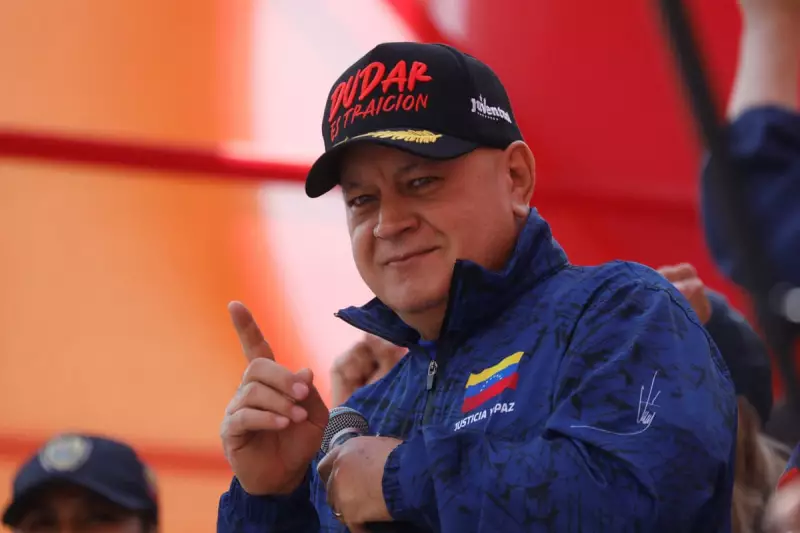
The Trump administration has issued a stark warning to one of Venezuela's most powerful figures, Interior Minister Diosdado Cabello, in the wake of the dramatic capture of former dictator Nicolás Maduro. According to reports, US officials have told Cabello he must lend his support to the new acting president, Delcy Rodríguez, or face consequences similar to those suffered by Maduro.
A Stark Ultimatum from Washington
US officials, deeply concerned that Cabello could sabotage Washington's plans for a managed transition, have delivered their message through intermediaries. The American strategy aims to keep certain figures from Maduro's inner circle in place to maintain stability, while securing a crucial prize: unrestricted access to Venezuela's vast oil reserves.
This objective was highlighted by Donald Trump himself in a post on Monday 5th January 2026, where he stated Venezuela would be "turning over" $2bn worth of crude oil to the United States. This deal is designed to divert supplies away from China and help Venezuela avoid further production cuts.

Cabello's Defiant Street Display
In response, Diosdado Cabello has taken to social media to project an image of strength and control. He has posted videos showing himself commanding dozens of heavily armed men patrolling the streets of Caracas. As the controller of the police, counterintelligence agencies, and the pro-government militia groups known as colectivos, his power base is substantial.
In one video from late on Tuesday 6th January, Cabello claimed, "It's calm, it's tranquil. Your conscious people know what we must do, working to restore the normality that should prevail in the country and get back to work." The footage also showed him interacting with civilians and shopkeepers.
Another clip featured dozens of armed men chanting loyalist slogans like "Always loyal, never traitors!" and "To doubt is to betray!" – the latter phrase was also emblazoned on the cap Cabello wore at Rodríguez's swearing-in ceremony. This gesture has been interpreted by analysts as a clear sign of resentment at not being placed in charge and a warning against making concessions to the US.
Internal Rivalries and a History of Abuse
The tension between Cabello and the acting president is long-standing. He has a well-documented rivalry with Delcy Rodríguez and her brother, Jorge Rodríguez, the president of congress. While many considered Cabello the regime's second-most powerful figure after Maduro, power was fractious, divided among competing factions.
A "core" Chavista who participated in Hugo Chávez's 1992 coup attempt, Cabello is also widely accused of being central to the regime's extensive human rights abuses. These include thousands of extrajudicial killings, enforced disappearances, torture, and the imprisonment of political opponents.
Since Monday, the colectivos under his command have intensified a crackdown, patrolling streets, operating checkpoints, and checking phones. The regime has declared a "state of external commotion," ordering the capture of anyone supporting the US attack. This led to the detention of at least 16 journalists and media workers, with 15 later released.
Acting President Rodríguez, meanwhile, has declared seven days of national mourning for victims of the US military strike and hardened her rhetoric against Washington. She stated "no external agent governs Venezuela," directly rebutting Trump's earlier claims, and labelled Maduro's capture a "kidnapping" resulting from a "criminal attack."
The situation remains precarious, with the US ultimatum to Cabello setting the stage for a critical power struggle within the remnants of the Chavista regime, with Venezuela's political future and its valuable oil resources hanging in the balance.






