

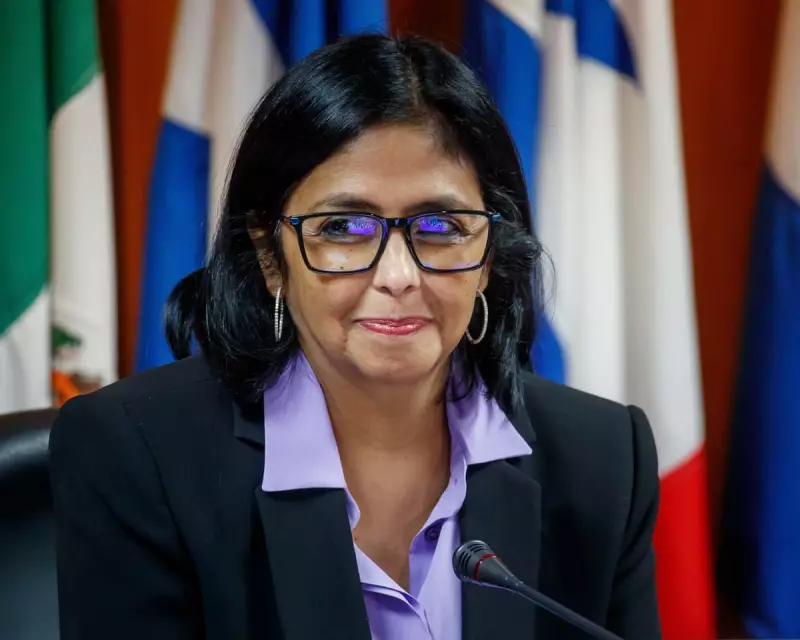
Delcy Rodríguez, a seasoned political figure who served as Venezuela's vice-president and oil minister, has taken the reins as the country's interim leader following the dramatic abduction of President Nicolás Maduro. In her first address, she struck a defiant tone, lambasting the United States and pledging loyalty to the absent Maduro, yet Washington appears to have calculated she is the figure they can work with.
A Defiant Speech and a Cold US Calculation
In a televised speech on Saturday night, the 56-year-old former labour lawyer condemned the seizure of Maduro and his wife, Cilia Flores, demanding their immediate return. "What is being done to Venezuela is an atrocity that violates international law," Rodríguez declared, adding, "There is only one president in Venezuela and his name is Nicolás Maduro."
Despite this public defiance, the administration of US President Donald Trump has made a stark assessment. Trump stated Rodríguez is "essentially willing to do what we think is necessary to make Venezuela great again," indicating a preference for her over other contenders. US Defence Secretary Pete Hegseth elaborated that 'running' Venezuela meant setting terms: halting drug flows, returning oil assets, and stopping the flow of criminals to the US.

The Pragmatic Technocrat in a Precarious Position
Rodríguez now walks a vertiginous tightrope. To retain power, she must accommodate Washington's significant demands while simultaneously shoring up an authoritarian regime that remains deeply unpopular with a large segment of the Venezuelan population. Her challenge is compounded by the need to placate the powerful military hierarchy, which was loyal to Maduro.
Where the Venezuelan opposition sees a key apparatchik of Maduro's dictatorship, the Trump administration reportedly sees a potential business partner. Senior US officials have indicated to outlets like the New York Times that Rodríguez, an English-speaking technocrat, impressed with her management of Venezuela's crucial oil industry. Intermediaries have convinced Washington she would protect future American energy investments.
Sidelined Opposition and the Shadow of Chávez's Revolution
This US pivot has sidelined opposition leader María Corina Machado, who mobilised Edmundo González's winning presidential campaign in 2023—a result Maduro ignored—and is a Nobel peace prize laureate. Despite her efforts to court Trump and support a US military buildup in the Caribbean, the US president stated she lacked the necessary support and that it would be "very tough" for her to lead, primarily due to her unacceptability to the military.
The leadership of the Bolivarian revolution, launched by Hugo Chávez in 1999, now falls to Rodríguez, a softly spoken yet flinty pragmatist. Her political pedigree is strong; her brother, Jorge Rodríguez, is the head of the national assembly, and she has held senior posts including foreign minister since joining Chávez's government in 2003. Notably, unlike many in Maduro's inner circle, she has not been indicted on US charges for drug trafficking.
For now, Rodríguez must perform a delicate balancing act. Her defiant rhetoric serves to placate regime loyalists and the military, while her technocratic background offers Washington a channel for influence. The ultimate fate of Venezuela's political crisis, however, remains suspended between internal fracture, popular uprising, and further US intervention.






