

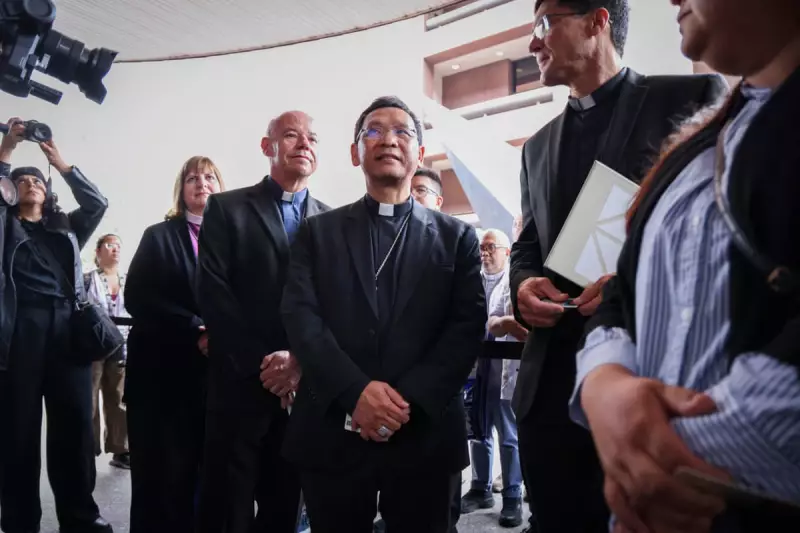
For Bishop Michael Pham, the stark corridors of the federal courthouse in San Diego are a world away from the fishing boat on which he fled communist Vietnam nearly five decades ago. Yet his own harrowing journey as a 13-year-old refugee directly informs his unprecedented mission today: personally accompanying immigrants to their deportation hearings and ICE check-ins.
From Refugee Boat to Bishop's Robes
In 1975, a teenage Michael Pham spent three days and four nights adrift in the Pacific Ocean with over a hundred others, surviving without food or water before reaching a Malaysian refugee camp. Now 58, he holds the powerful position of Bishop of San Diego, appointed by Pope Francis as the first Vietnamese American to head a US diocese. His profound personal history with displacement is the driving force behind his very public, pastoral intervention in the US immigration system.
"It's overwhelming," Pham reflected from his diocesan offices. "I never thought I would be in this position." That position now sees him and a growing coalition of faith leaders offering a visible, spiritual presence at the city's immigration court, a site of intense enforcement activity.

A Ministry of Presence in the Courthouse
The initiative, named Faith (Faithful Accompaniment in Trust and Hope), was launched in August 2025. It was born from a spontaneous decision Pham made after a successful first visit to the courthouse in June. He had dismissed suggestions from within the church to simply offer blessings from a distance, insisting, "If I said I want to do something, I need to follow through."
The context for this ministry is a sharp rise in ICE enforcement. According to local watchdog groups, at least 170 arrests were made at the San Diego immigration court in a three-month span during the summer of 2025. Agents frequently waited in hallways to detain individuals immediately after court appearances.
Father Scott Santarosa, a Jesuit pastor helping to lead the Faith ministry, describes the earlier scene as one of "uniquely American chaos," with masked ICE agents "lurking" and families gripped by terror. The clergy's presence, he believes, has altered the dynamic. "When you have nuns and priests standing next to these ICE officers, and we have rosary beads in our hands, and they have handcuffs on their belt, it's not a good look for them," Santarosa noted.
An Exercise in Powerless Solidarity
The ministry has trained roughly 500 volunteers from 17 different faith backgrounds, who take shifts at the courthouse every day it is in session. Their role is one of accompaniment, prayer, and witness. Santarosa candidly admits the work is "an exercise in powerlessness," as they cannot legally intervene in proceedings. However, their consistent presence appears to have forced a change in ICE tactics, with arrests increasingly happening out of public view in private check-in rooms.
"As [ICE has] made adjustments, it's slowed down the number of arrests," Santarosa observed. The human impact is profound. The ministry is assisting individuals like a father from Guerrero, Mexico, who has lived in the US for over twenty years and fears for his family, including his five-year-old daughter. Data underscores the scale of the issue: nearly 60% of people arrested by ICE in San Diego and Imperial counties have no criminal histories.
Leading a Divided Flock
Bishop Pham's leadership on immigration occurs against a complex backdrop. He inherited a diocese grappling with the legacy of the Catholic sex abuse scandal, with 457 new claims filed after a California law temporarily lifted the statute of limitations. Furthermore, he must navigate deep political polarisation within his own congregation, where about half of Catholic voters reportedly support stricter immigration policies.
For Pham, the issue transcends politics. He points to a recent "special message" from hundreds of US bishops opposing "indiscriminate mass deportation." His approach is one of dialogue, inspired by Pope Francis. "We enter into a dialogue and come to a greater understanding of where people are," he said. "And if we can do that, transformation of the heart can take place."

For Father Santarosa, the theological imperative is clear. "Jesus, in the Gospels, always sides with the poor, the outcast, the stranger," he stated. "Now it's immigrants. I think we've got to stand with them as much as we can." Through the simple, powerful act of showing up, Bishop Pham and his interfaith volunteers are translating that conviction into concrete solidarity, one courtroom hallway at a time.





