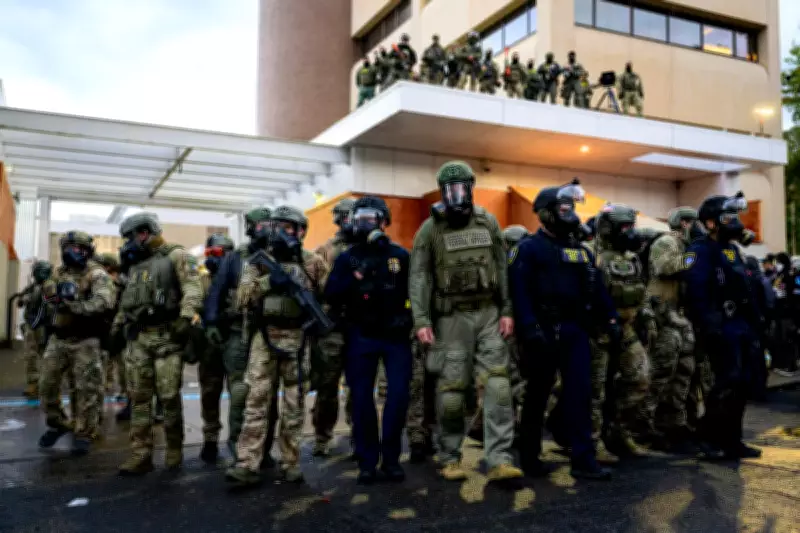
ICE Agents Exposed: Daily Arrest Quotas and Secret Surveillance App in Oregon
Federal agents from Immigration and Customs Enforcement (ICE) in Oregon have been compelled to testify under oath, revealing the use of a custom-made surveillance app and daily arrest quotas during operations. This testimony emerged from a class-action lawsuit filed by Innovation Law Lab, an immigrants' rights non-profit, which challenged ICE's practice of detaining individuals without warrants or probable cause.
The lawsuit argued that these tactics led to widespread racial profiling and unconstitutional arrests. A federal judge sided with the plaintiffs, issuing a ruling that broadly halts warrantless arrests in Oregon. The testimony provides a rare glimpse into the internal strategies of ICE, which are typically kept secret and have driven mass detentions and chaotic raids.
Daily Arrest Quotas and Operation Black Rose
In a December hearing, an ICE agent identified as JB testified that his team received a verbal order to target eight arrests per day. This team, consisting of nine to 12 officers, was part of the Department of Homeland Security's (DHS) "Operation Black Rose," launched in Portland last fall. Through mid-December, this operation yielded over 1,200 arrests across Oregon.

When asked about complying with the quota, JB responded, "I made as many arrests as I could, as long as it was lawful." This testimony appears to contradict repeated claims by DHS officials that officers do not have quotas. Notably, Trump adviser Stephen Miller has publicly stated the administration's target was 3,000 daily arrests nationwide.
Surveillance App Elite: A Tool for Targeting
The hearing also marked the first time ICE disclosed in court its use of an app called Elite for operations. JB described Elite as a "newer app" similar to Google Maps, which shows how many individuals with an "immigration nexus" are believed to be in a specific area. An "immigration nexus" could include any history of contact with immigration officials, potentially even naturalized U.S. citizens.
JB explained that Elite helps officers identify areas with a "dense population," meaning a higher likelihood of finding people to detain. However, he acknowledged that the app's information could be inaccurate, stating, "The app could say 100%, and it's wrong. The person doesn't live there. It's a tool that we use that gives you probability, but there's ... no such thing as 100%." Officers are required to conduct checks on the intelligence provided by Elite.
Case Study: Woodburn Operation
JB's testimony centered on a 30 October ICE operation in Woodburn, a city south of Portland known for its agricultural workforce. Officers surveilled an apartment complex, partly based on intelligence from Elite, and pulled over a van of farm workers early in the morning. They smashed the car windows and detained all seven occupants.
JB claimed the team became suspicious when the driver made multiple stops for passengers, suggesting potential human trafficking or smuggling. He noted that the occupants speaking Spanish during the stop seemed to confirm these suspicions. However, ICE's written report made no reference to trafficking concerns, and JB later admitted that one occupant's statement about going to work from Mexico "cancels out human trafficking."
During the operation, another ICE agent used Mobile Fortify, DHS's facial recognition app, to photograph a farm worker named MJMA, the lead plaintiff in the case. The app showed a match, but the officer testified he was unsure if it was accurate. MJMA had entered the U.S. with a valid temporary visa, yet ICE records inaccurately stated she entered unlawfully and described the van stop as "consensual." She was detained in Washington state before being released without explanation.

Judicial Criticism and Legal Implications
U.S. Judge Mustafa Kasubhai sharply criticized ICE's tactics in Woodburn, noting that Elite could surface inaccurate information and lead to targeting of people lawfully in the U.S. He called JB's claims of human smuggling "unfounded" and "inappropriate," suggesting ICE targeted the area simply because many farm workers lived there. The judge wrote that to meet the president's demands for 3,000 daily arrests, ICE officers arrested an "extraordinary" number of Oregonians with little regard for lawful procedures.
Stephen Manning, executive director of Innovation Law Lab, argued that the drive to meet arrest quotas can lead officers to violate rights and ignore legal protections. He cited the violent arrest of Juanita Avila, a legal permanent resident, as an example of racial profiling driven by quotas. Avila was pulled over in November, tackled to the ground despite having her green card, and recently spoke about the ordeal.
Elite App Details and Corporate Involvement
Many details about Elite's functions remain unclear, but reports from tech news site 404 Media in January indicated the app was built by Palantir, a data analytics firm with contracts with DHS and the Department of Defense. Internal ICE materials suggest Elite populates a map with potential deportation targets, generates dossiers on individuals, and provides a "confidence score" on addresses. Elite stands for "Enhanced Leads Identification & Targeting for Enforcement" and identifies "high-value targets" with a geospatial mapping feature.
Palantir has not responded to inquiries about Elite, describing itself as a "data processor" that does not play an active role in clients' data collection efforts. DHS and Department of Justice spokespeople also did not respond to detailed questions about the app, arrest quotas, or the Oregon lawsuit.
Nelly Garcia Orjuela, a staff attorney with Innovation Law Lab, stated that Elite reveals "another level of surveillance and how much information ICE has at their fingertips." She argued that officers are not targeting individuals with serious criminal records as claimed by DHS but instead are "going around the law" to target vulnerable communities.
This case highlights ongoing debates over immigration enforcement, surveillance technology, and civil liberties in the United States, with significant implications for policy and legal frameworks moving forward.