

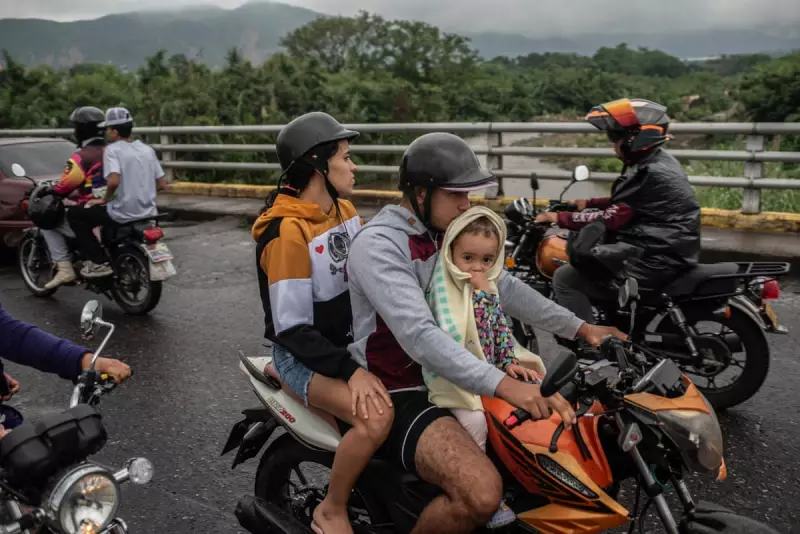
The city government of Cúcuta in north-eastern Colombia has officially registered the arrival of more than 2,000 displaced people from the Catatumbo region since 22 December, with numbers expected to rise. Civilians are fleeing a fierce offensive between rival guerrilla groups vying for control of the volatile, resource-rich border zone with Venezuela.
Flight from a War Zone
Among the displaced is a man identified only as Alberto, who arrived in Cúcuta with his wife and seven-year-old son after fleeing their village of Pacelli. "We can't take it any more," he said, nervously handling his family's documents at the Human Rights Ombudsman's office while seeking humanitarian aid. Like many, he requested anonymity for fear of retribution from the armed groups.
The offensive is part of a battle for control of Catatumbo, an area notorious for its illegal coca crops, cocaine laboratories, and porous border with Venezuela. The conflict pits the National Liberation Army (ELN) against a dissident faction of the demobilised Revolutionary Armed Forces of Colombia (FARC), known colloquially as "Calarcá's dissidence."

A Conflict Fought with Drones and Fear
The recent surge in violence comes in the wake of the 3 January US operation in Venezuela to capture President Nicolás Maduro, who now faces federal charges in New York. While not directly linked, analysts warn the political shake-up in Caracas could eventually impact the dynamics in Catatumbo, given the ELN's established links with elements of the Venezuelan National Guard.
The fighting has taken a terrifying new turn, with both groups reportedly using armed drones to target enemies and suspected collaborators. "People tell me they are nervous working their fields, constantly on the lookout for the drones," said Eliana Zafra of the Permanent Committee on Human Rights in Cúcuta.
For Juliana, a 50-year-old farmer from Filo Gringo, the constant humming of drones contributed to her husband's fatal heart attack. Days later, FARC dissidents ordered her to abandon her land immediately. "I didn't even have time to pack some clothes," she recounted at the ombudsman's office.
Regional Instability and a Stalled Peace Process
The Cúcuta authorities have registered 2,048 displaced individuals, with many more believed to have fled to the city of Ocaña. This displacement adds to a grim toll; at the start of 2025, over 60,000 people were forcibly displaced from Catatumbo due to combat and selective killings.
Security analyst Javier Flores of the Ideas for Peace thinktank notes the 33rd Front dissident group has strengthened through ongoing, albeit separate, peace talks with the Colombian government of President Gustavo Petro. "What we see now is them trying to retake control of Catatumbo," Flores stated.
The ELN, with an estimated 6,000 combatants operating in over a fifth of Colombia's municipalities and eight Venezuelan states, is deeply entrenched in the drug trade. Its support for the Maduro government has led some to label it a paramilitary force within Venezuela.
Despite the US action in Caracas, Flores doubts an immediate change in border criminal dynamics, as Maduro's inner circle remains largely intact. However, he warns that future US pressure on Venezuela to crack down on the ELN could push fighters back into Colombia, further destabilising Catatumbo.
For humanitarian workers like Eliana Zafra, the outlook for civilians is bleak. "Whatever happens, this won't be good for the civilian population of Catatumbo," she said. "The conflict is going to intensify even more."






