

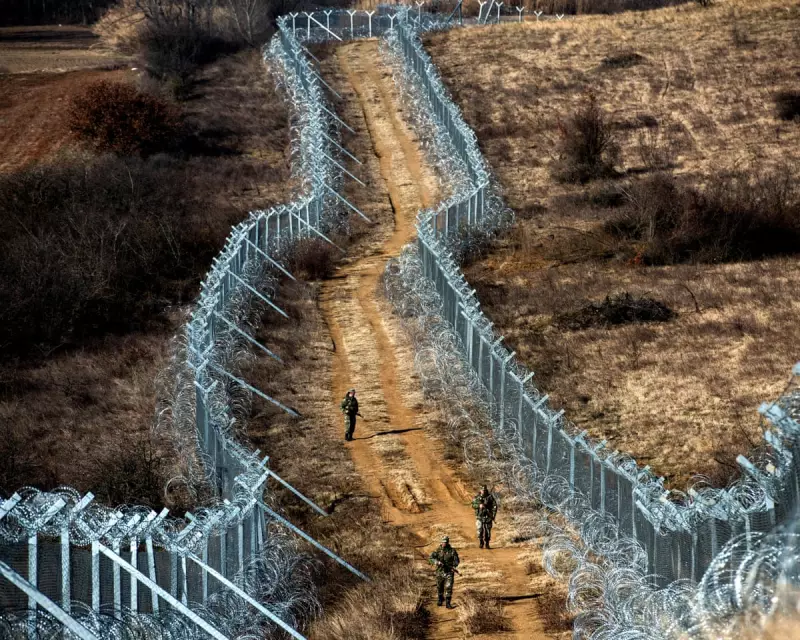
A stark photograph of razor wire at the EU's external border between Greece and North Macedonia symbolises a deepening European paradox. While US President Donald Trump's recent national security strategy, laced with anti-migrant rhetoric and Islamophobic undertones, was met with official dismay in Brussels, an awkward truth lingers: on several key issues, Europe's trajectory is moving closer to the worldview he espouses.
A Muted Response to Provocation
European leaders offered only tepid rebuttals to Trump's inflammatory claims. European Council President António Costa did denounce plans to boost Europe's far-right parties but failed to publicly dismantle the racist logic framing migrants as a threat to European civilisation. Similarly, European Commission President Ursula von der Leyen called for unity and pride in response to Trump's insults, yet notably omitted a robust reaffirmation of her own past vision for an inclusive Union where background does not matter.
The reality, as commentators note, is that Trump's caricature of a 'woke' Europe overrun by migrants is laughably out of touch. Far from feeling alienated, he would find much that is familiar in today's EU political landscape. Far-right parties are gaining significant ground, and the toxic 'great replacement' conspiracy theory has seeped from the extremist fringe into mainstream political discourse. Von der Leyen's own conservative bloc frequently depends on far-right votes to pass legislation in the European Parliament.

Convergence on Migration and Security
The methods employed by the EU and the US to manage migration are increasingly aligned. The EU's new Migration Pact, while not employing paramilitary tactics, explicitly tightens asylum procedures, speeds up deportations, and expands detention capacities. Many member states are pushing for more 'innovative solutions', including bolstering the powers of Frontex, the border agency repeatedly accused of human rights violations and complicity in illegal pushbacks.
In a significant move, twenty-seven European states have formally requested a revision of the European Convention on Human Rights, arguing that the rights of migrants must be balanced against the 'security' and 'freedom' of European citizens. This securitisation framework, which normalises exemptions from human rights norms, plays directly into the narrative favoured by Trump and his European sympathisers.
This hardening stance exists in direct contradiction to the EU's economic needs. The European Commission itself has identified severe labour shortages in 42 critical occupations, from healthcare and social care to construction and transport—sectors vital for the bloc's strategic autonomy. Consequently, even as politicians compete to sound tough on borders, numerous EU governments are quietly signing labour partnership agreements with countries in the global south.
The Silencing of Progressive Voices
While Trump claims nationalist parties face censorship, the crackdown in Europe is often felt by progressives and those advocating for Palestinian rights. UN experts have called on Germany to halt persistent police violence against Palestinian solidarity activism. In France, a major international academic conference on Palestine was forced to relocate from the Collège de France after a government minister publicly smeared it as mere 'activism'.
As Dutch socialist MEP Mohammed Chahim points out, Europe's media and political ecosystems have constructed an 'imaginary Muslim' who is perpetually a suspect and a security risk, never a doctor, scientist, or elected representative. This narrative is so entrenched that even evidence-based research, such as a Dutch government study revealing structurally embedded anti-Muslim discrimination, can be sidelined, with parliament refusing to discuss its findings.

The ultimate irony is that Europeans of colour do not wield the disproportionate power Trump attributes to them. Many face marginalisation and structural discrimination. Yet, far from plotting civilisational demise, countless individuals are working to ensure Europe's survival and prosperity through contributions in politics, business, technology, culture, and science. The pressing question is whether responsible European leaders will finally find the courage to publicly reject Trump's toxic fiction of a white, Christian Europe and wholeheartedly celebrate the continent's actual diversity.





