

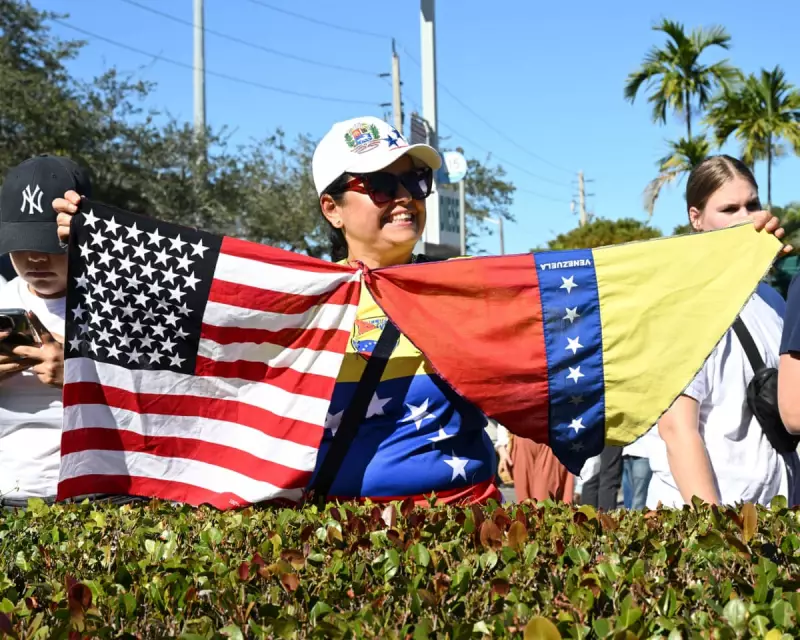
Hundreds of Venezuelan expatriates flooded the streets of Doral, Florida, on Saturday, erupting in celebration at the news that their country's president, Nicolás Maduro, had been captured by US military forces. The crowd, waving national flags and chanting for freedom, gathered outside the El Arepazo restaurant, a traditional hub for the local community where up to 40% of the suburban Miami city's population is of Venezuelan origin.
From Euphoria to Uncertainty
The initial euphoria was palpable as details emerged of the pre-dawn operation that saw Maduro and his wife, Cilia Flores, taken from their beds and flown to New York City to face court proceedings. The mood, however, shifted following a press conference by former US President Donald Trump. His announcement that the United States would temporarily assume control of Venezuela and that American businesses would take over its lucrative oil infrastructure left many in the diaspora deeply concerned.
Trump's vision conspicuously sidelined popular Venezuelan opposition figures like Edmundo González and Nobel peace prize laureate María Corina Machado. Instead, he issued a veiled threat, stating, "We are ready to stage a second and much larger [military] attack if we need to do so." For the large Venezuelan community in South Florida, this move raised immediate alarms, particularly given Trump's prior action—upheld by the Supreme Court in October—to strip immigration protections from hundreds of thousands of Venezuelans in the US.

Deportation Fears Loom Over Celebration
Experts warned that the new US-led administration in Caracas could accelerate the deportation of Venezuelan refugees. Eduardo Gamarra, a professor of politics at Florida International University, questioned the logic, noting Trump's rhetoric focused on enabling people to return to a "free Venezuela."
"He didn't say anything of all the refugees, the people who lost their temporary protected status," Gamarra said. "What you might see is an accelerated path of deportations, but you might call them repatriations now." This potential consequence cast a shadow over the festivities in Doral, with Gamarra pondering how many celebrants would actually be willing or able to return.
Political Divide and Cautious Hope
The political reaction in Florida split along partisan lines. Republican Representative Carlos Giménez hailed Maduro's ouster as akin to the "fall of the Berlin Wall," praising Trump for changing history. In stark contrast, Democratic Representative Maxwell Frost, who is Cuban-American, condemned the action as "illegal, dangerous, and outside the bounds of his constitutional authority."
Frost echoed concerns about deportations, criticising Trump for being willing to "risk American and Venezuelan lives for political gain" while refusing to extend Temporary Protected Status to those fleeing the crisis. Despite the political and practical uncertainties, some within the community saw a glimmer of opportunity. Leonardo Trechi, president of the Venezuelan American Chamber of Commerce, described Maduro's detention as a "relief" and an "opportunity" for the diaspora to contribute to Venezuela's reconstruction.
Similarly, Celestino De Caires, a Venezuelan-born California resident, expressed hope for his homeland, where grandparents often raise children because parents were forced to migrate for work. "People in Venezuela are hungry," he said, "and their wellbeing depends on this transition." The day's events in Doral thus captured a complex mix of unbridled joy for Maduro's fall and profound wariness about what comes next.






