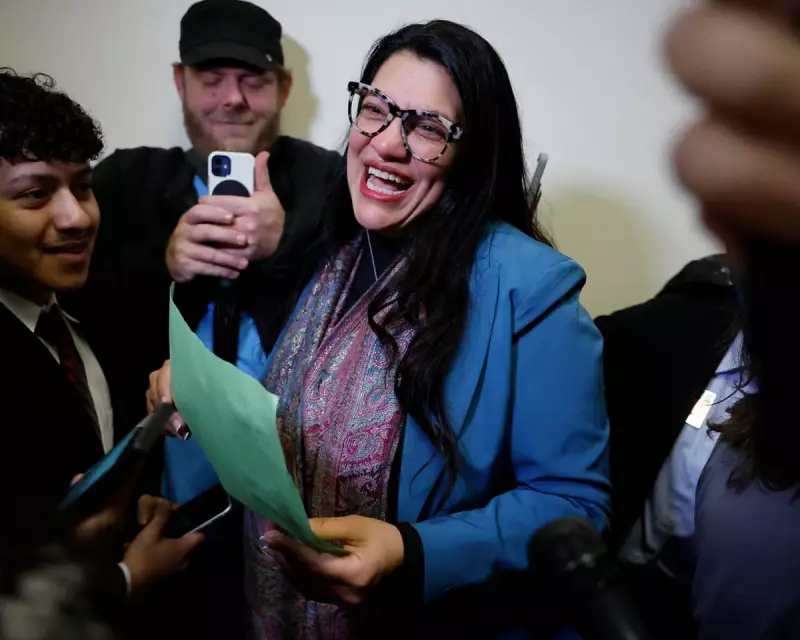
Democratic Representative Rashida Tlaib is launching a direct legislative assault on what she terms America's 'billionaire oligarchs', with a new bill urging Congress to halt their political and economic dominance.
The 'Defund the Oligarchy' Resolution
On Tuesday, Tlaib plans to introduce a resolution in the House of Representatives calling for an end to the corporate subsidies and tax advantages that fortify the power of the ultra-wealthy. The legislation advocates for a major reinvestment in the American people to, in her words, 'defend democracy from authoritarianism'.
The move is backed by the political organisation Our Revolution, born from Senator Bernie Sanders' 2016 presidential campaign. The group is simultaneously launching a 'Defund the Oligarchy' campaign, armed with research showing individuals and corporations who funded Donald Trump's election received an astronomical return on their investment.

'It's out of control,' Tlaib stated in a recent interview. 'Our resolution urges Congress to act to address it and reinvest in the needs of the American people.' She pointed to a perceived imbalance in national priorities, questioning why there is 'always money to bomb Venezuela and continue to fund a genocide in Gaza' but not for universal healthcare.
Staggering Returns for Mega-Donors
Research compiled by Our Revolution presents a stark picture of the financial windfalls reaped by key Trump supporters. The analysis found that the former president's biggest donors in sectors like crypto, oil and gas, and deportation infrastructure spent roughly $700 million boosting his campaign and the wider MAGA movement.
In return, they received policies and tax benefits estimated to be worth a staggering $172.5 billion. This translates to an average return of 18,000% on capital, meaning every $1 million donated yielded an $18 billion windfall.
The oil and gas industry led the charge, spending $443 million. Their reward was some $153 billion in tax breaks, the rollback of climate regulations, and a dismantling of renewable-energy initiatives—an estimated 33,443% return on investment.
Private contractors in the detention sector also profited immensely. Firms like GEO Group and CoreCivic gave nearly $5 million, and in return stand to gain from policies aiming to quadruple immigrant expulsions, representing an 11,050% return.
Public Appetite for Change and Political Hurdles
Tlaib believes there is a significant public hunger for this change, citing a Pew Research survey where 63% of US adults said tax rates on big businesses should be raised. She also referenced the success of figures like democratic socialist Zohran Mamdani in New York's mayoral race on a 'tax the rich' platform.
However, the congresswoman admits the path forward in Congress is uncertain. While the bill has support from fellow progressive Pramila Jayapal, Tlaib is sceptical about wider Democratic backing. 'A majority of them do take corporate donations,' she noted, arguing the party needs to wake up to the fact that many of their donors are the same interests hurting working families.
Joseph Geevarghese, Executive Director of Our Revolution, emphasised that the fight must go beyond slogans. 'It has to be defunding oligarchy as a governing programme,' he said. The group's initiative aims to turn anti-oligarch sentiment into concrete political action through a candidate pledge and an accountability project.
Undeterred by expected attacks from right-wing media, Tlaib remained defiant. 'The American people, no matter the political affiliation... overwhelmingly want to tax the rich,' she concluded.