

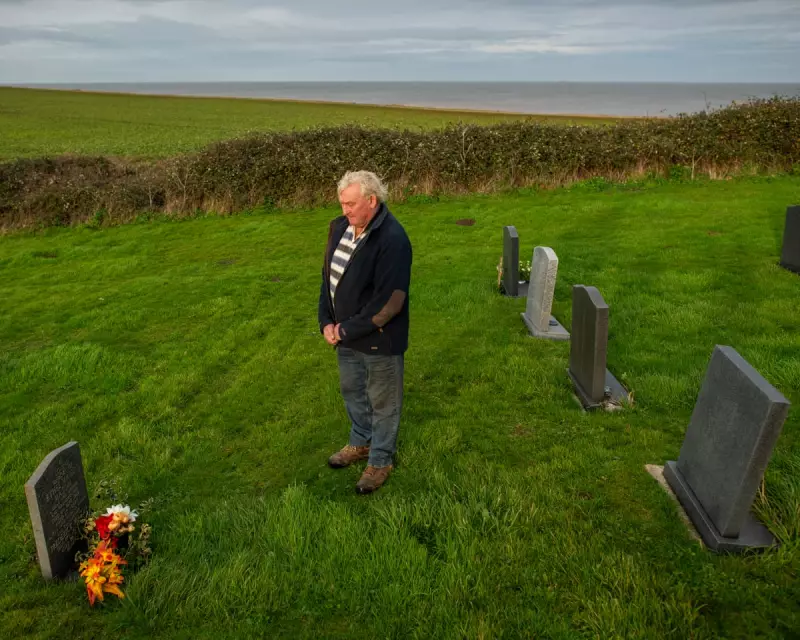
Bereaved families in Norfolk are experiencing profound distress as the final resting places of their loved ones face an existential threat from the encroaching sea. The anguish is compounded by what they describe as a painful lack of decisive action from authorities.
Graveyards on the Brink
North Norfolk District Council (NNDC) has identified three church graveyards as being at direct risk from coastal erosion in the coming decades. The burial grounds in the villages of Happisburgh, Trimingham, and Mundesley could be lost to the waves. A recent council report outlines a spectrum of potential responses, ranging from taking no action to the exhumation and reburial of remains in safer locations. Both the council and the Church of England maintain that the decision on how to proceed must come from the local communities themselves.
This need for consensus, however, has left many families feeling trapped in a state of anxious limbo. Frank Mason, 69, whose parents Ethel and Fred are buried in Happisburgh, voiced a common sentiment. "At the moment we're in limbo. It upsets me," he said. "My parents wanted this to be their final resting place, but it isn't going to be because of the sea."

Families Haunted by the Past, Anxious for the Future
While official projections suggest parts of the Happisburgh churchyard may fall into the sea within 80 years, Mason, a local farmer, fears it will happen in less than 20. His fear is shaped by a grim local precedent. He and others are haunted by the fate of the neighbouring village of Eccles, where a church and its graveyard have almost entirely disappeared into the North Sea.
Sarah Greenwood, whose grandparents are also buried at Happisburgh, recalled visiting Eccles on a school trip. "You could see people's bones," she said, dismissing any romantic notion of remains being peacefully washed out to sea. "People will take bones as souvenirs and go grave robbing looking for valuables. It's completely undignified." Greenwood, who runs a packing business, believes the threat's immediacy has been exaggerated but accepts relocation will one day be necessary. She advocates for more sea defences to slow the erosion and allow burials to continue for now.
The emotional toll is severe. Greenwood admitted the situation made her "ill over the summer," while Frank Mason is "disgusted" by the prospect of skeletons on the beach. He wishes to see his parents moved before he passes away, suggesting relocation to the village's highest point, but feels his concerns are ignored.
A Call for Clarity and Compassion
Further up the coast in Trimingham, Barbara Crouch faces a similar heartache. Her son Nicholas, a former paratrooper killed in Iraq in 2010, is buried there. Learning his grave might be moved robbed her of sleep. "It does disturb me to think this won't be his permanent resting place. For us it's an important place to go," she said, referring to the family's annual gatherings on the anniversary of his death.
Crouch, a retired teacher, believes new burials should be halted but thinks it is too soon to exhume existing graves. Her preference is to monitor the situation closely, but she insists an early decision must be made once a tipping point is reached. She calls for clear consultation with families and a defined timetable. "It ought to be settled, because I was temporarily deeply unsettled by it," she stated. "I hope it doesn't get lost in the talking."
When the time comes, Crouch would favour a collective exhumation. "It would be more bearable to do it together," she explained.
Rob Goodliffe, a coastal transition manager at NNDC, clarified that the graveyards are owned and managed by the Diocese of Norwich. "Ultimately it is down to them to decide the direction to take. We are here to help support them through that process with communities," he said. He confirmed all options are being considered but noted there are decades before land is lost, allowing time for deliberation.

The Bishop of Norwich, Graham Usher, acknowledged the lack of a common view. "We need good local conversations to find the right solutions for each community," he said. He described the potential loss as one of "immense sadness," but added, "the Christian church believes in resurrection. We believe there is life after death." For the grieving families on the Norfolk coast, however, the pressing concern remains the dignity and security of their loved ones' earthly remains.





