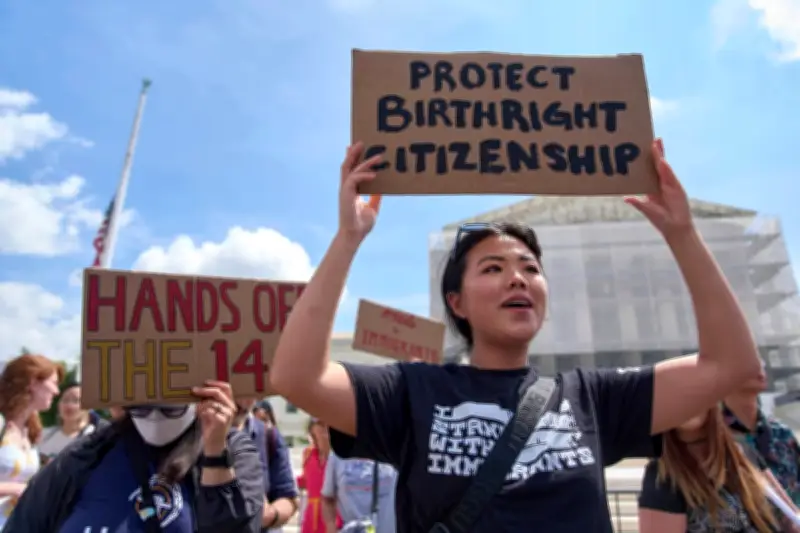
The US Supreme Court delivered a decisive blow to President Donald Trump's anti-immigration agenda, ruling that his executive order attempting to end birthright citizenship violates the 14th Amendment. The decision, released on May 15, 2025, affirms that children born in the United States to parents who are unlawfully present or temporary visitors are citizens at birth.
Supreme Court Ruling
Chief Justice John Roberts wrote the majority opinion, joined by liberal justices Sonia Sotomayor, Elena Kagan, Ketanji Brown Jackson, and conservative justice Amy Coney Barrett. Justice Brett Kavanaugh concurred in part but dissented on the constitutional question. The ruling stated: "Children born in the United States to parents unlawfully or temporarily present are 'subject to the jurisdiction' of the United States and are citizens at birth under the Fourteenth Amendment's Citizenship Clause."
The decision rebukes the Trump administration's argument that children of undocumented immigrants and temporary foreign visitors are ineligible for citizenship. Trump issued the executive order on the first day of his second term, drawing immediate lawsuits from Democratic state attorneys general and the American Civil Liberties Union (ACLU). The ACLU argued the case in April 2025 in Trump v. Barbara, a class-action challenge brought by affected parents.

Legal Basis for Birthright Citizenship
Birthright citizenship, or jus soli ("right of the soil"), grants citizenship to nearly everyone born on US soil. This principle derives from English common law but was codified in the US Constitution after the Civil War. The 14th Amendment, ratified in 1868, overturned the 1857 Dred Scott decision that denied citizenship to Black descendants of enslaved people. The Citizenship Clause states: "All persons born or naturalized in the United States, and subject to the jurisdiction thereof, are citizens of the United States and of the State wherein they reside."
Historical precedent includes the 1898 case United States v. Wong Kim Ark, where the Supreme Court ruled that a man born in San Francisco to Chinese immigrant parents was a US citizen, even though his parents could not naturalize. Exceptions to birthright citizenship are rare: Indigenous peoples were excluded until 1924, people born in American Samoa are not automatically citizens (as ruled in 2021), and children of foreign diplomats or enemy occupiers lack birthright citizenship.
Trump Administration's Argument
Trump's executive order sought to redefine the 14th Amendment's phrase "subject to the jurisdiction thereof," arguing that children of non-citizen parents who are unlawfully present or on temporary visas (e.g., tourists, foreign students) are not subject to US jurisdiction. The order aimed to restrict citizenship to children of citizens or lawful permanent residents with "domicile" in the US. Trump claimed birthright citizenship was a "scam" that "ripped off" taxpayers. However, during oral arguments, the government's lawyer conceded that "no one knows for sure" the extent of "birth tourism." The Center for Immigration Studies estimates 20,000 to 26,000 births annually to women on tourist visas—less than 1% of all US births.
Dissent and Concurrence
Conservative justices Clarence Thomas, Samuel Alito, and Neil Gorsuch dissented. Thomas wrote nearly 90 pages, arguing that Black people were entitled to citizenship because they had "no other homeland," unlike children of foreign temporary visitors. Alito called the decision "one of the most important" but a "serious mistake," suggesting Congress should address the issue. Kavanaugh wrote that while the executive order does not violate the 14th Amendment, it violates a federal statute; Congress could amend the statute to create exceptions.
Justice Jackson's concurrence emphasized the 14th Amendment's "universalist aims," stating: "The America that was reborn from the rubble of the Civil War simply does not countenance that inequitable result."

Impact and Next Steps
Trump called the ruling "too bad" but insisted on Truth Social: "Congress should start TODAY to work on ending expensive and unfair to our Country, Birthright Citizenship." Overturning a constitutional amendment requires a two-thirds majority in both chambers or a constitutional convention, a high bar. Instead, Trump pushes for legislation to create exceptions, but any bill must overcome the 60-vote filibuster, a frequent hurdle for divisive bills in his second term.