

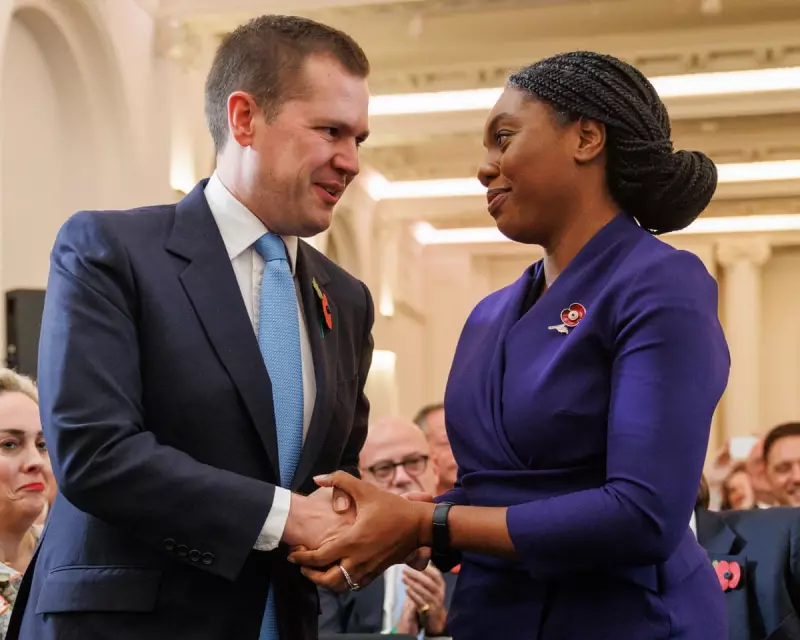
The political drama unfolding on the British right increasingly resembles a long-running family feud, where the warring factions share more DNA than they care to admit. The recent, explosive defection of Robert Jenrick from the Conservative Party to Reform UK is the latest act in a struggle that feels less like an ideological revolution and more like a bitter dispute over who gets to lead the same choir.
A Rift in the Ranks: Jenrick's Defection and the Battle for Supremacy
The events of late October 2024 brought the internal conflict into sharp relief. New Conservative leader Kemi Badenoch discovered her former colleague's plan to cross the floor. His subsequent, swift sacking was followed hours later by a press conference alongside Nigel Farage, cementing Jenrick's new political home. In the fallout, Jenrick labelled the Tories a "posh party" out of touch with ordinary people, while Badenoch framed his removal as part of "cleaning out the rubbish."
Farage, attempting to manage expectations, insisted Reform was not a "rescue charity for every panicky Tory MP" and set a loose deadline for further defections. Yet, these theatrical pronouncements only underscored the reality: this is a battle within a single, fractious political tradition, not a clash of opposing worldviews.

Shared Roots: The Common Thread of Thatcherism and Brexit
Despite the personal animosities, the ideological overlap between the two camps is profound. Both are deeply attached to the legacy of Brexit and the secular religion of Thatcherism. Their modern focus is fixed intently on immigration and the so-called culture wars. Farage's own political journey is archetypally Tory; his first inspiration was a lecture by Margaret Thatcher's guru, Keith Joseph, and he has long claimed to be keeping "the flame of Thatcherism alive."
His lieutenant, Richard Tice, only ended his Conservative membership in 2019. In a speech last year, he championed fiscal conservatism and cited the City's 'Big Bang' deregulation as a model—a classically Tory economic vision. Their grievance is not with conservatism's core tenets, but with the version of it embodied by the Cameron-Osborne era: socially liberal, metropolitan, and dominated by the Oxbridge-educated 'Notting Hill set.'
Farage and Tice, one without a university degree and the other a Salford graduate, represent a push to return conservatism to the demotic, bullish style of the Thatcher years, shedding its later attempts at modernisation.
Two Bands, One Playlist: The Uncomfortable Truth for the Tories
This convergence presents an existential problem for the Conservatives. When challenged on how his views differed from Jenrick's on issues like illegal immigration, new shadow justice secretary Nick Timothy could only argue that voters should choose the Tories for "the real deal." It was an admission that both parties are, metaphorically, singing from the same songbook, with the Tories merely claiming to perform the tunes better—a precarious argument when facing a populist challenger.
The comparison drawn by commentator John Harris is apt: the split mirrors the rupture in the reggae band UB40. That band fractured in 2008 over business disputes, not music, leaving fans to choose between two acts with the same name and a near-identical repertoire. For now, both bands coexist, but politics is less forgiving. On the ideological spectrum, there is typically room for only one dominant force.
The danger of a Reform UK government is real, and many traditional Tories are acutely aware of it. Yet, after a decade of rightward drift, a potential Farage-led takeover of the British right may not signify a clean ideological break. Instead, it could culminate in something both ardent right-wingers and estranged band members might ultimately desire: a stormy, dramatic, and definitive reunion.






