

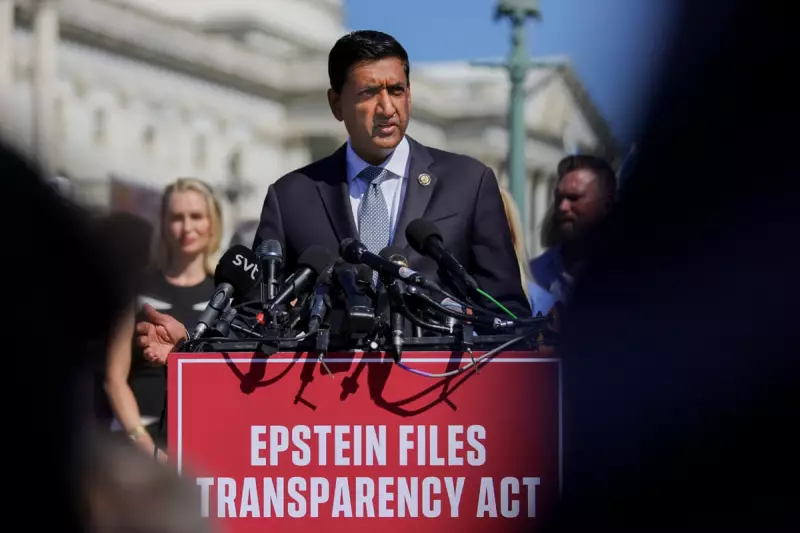
In a significant move for transparency and accountability, thousands of sealed documents related to the Jeffrey Epstein sex-trafficking network have been forced into the public domain. This landmark disclosure is the direct result of the Epstein Files Transparency Act, a piece of US legislation that moved from concept to law in an unusually swift five months.
The Man Behind the Bill: A New Theory of Bipartisanship
The architect of this act is Democratic Representative Ro Khanna of California. In an exclusive interview from his Washington office, Khanna explained that the forced release represents a potential reckoning for powerful figures who have evaded scrutiny. "I believe that this is going to be a reckoning for America," he stated, referring to the "Epstein class" of influential individuals implicated in the scandal.
Khanna's success with the Epstein Act is not an isolated incident. It is part of a series of improbable legislative victories that defy Washington's typical gridlock. His approach challenges conventional wisdom, arguing that common ground is not found solely in the political centre, but often at the populist edges where both the left and right share anger towards a system they believe has failed.

"The places where you can find common ground is not on incremental policy," Khanna asserts. His philosophy is built on three pillars: "Good jobs at home, no dumb wars overseas, accountability for elites." This framework aims to build what he terms a "modern FDR coalition", bridging progressive voters and disaffected supporters of the MAGA movement.
Building Unlikely Coalitions: From Yemen to Semiconductors
Khanna's theory has been tested and proven in several major legislative fights. A key early example was the 2019 Yemen War Powers Resolution. This marked the first time Congress used the War Powers Act to direct an end to US involvement in an ongoing conflict. To achieve this, Khanna, alongside Senator Bernie Sanders, built an alliance with libertarian Republicans like Thomas Massie, Rand Paul, and Mike Lee.
"We had Trump as president, and we had a Republican Senate," Khanna recalls, highlighting the unlikelihood of the coalition. The assassination of journalist Jamal Khashoggi was a catalytic moment, but the groundwork of relationship-building had been laid over months.
Another major win was the Chips and Science Act of 2022, the largest industrial policy bill in generations. This two-year effort began during the Trump administration with Republicans like former congressman Mike Gallagher and Senator Todd Young, eventually passing under President Biden to reshore semiconductor manufacturing to the US.
The Mechanics of Success: Relationships and Institutional Savvy
When asked about the practical mechanics of his bipartisan success, Khanna offers specific advice. First, master the rules and procedures of the institution. Second, and most crucially, build genuine, trusting relationships with a handful of members across the aisle.
"You’ve got to have people on the other side... where you can really text each other, call each other, be able to do more than just put your name on a bill," he explains. This trust, or "muscle memory" from previous collaborations, was vital for the rapid success of the Epstein Act. After securing a single Republican vote from Ralph Norman in committee, Thomas Massie helped gather more support.
Khanna is candid about the challenges, noting every bill almost fell apart and initially had perhaps a 5% chance of success. The Epstein Act faced opposition from then-President Trump, who was "campaigning and threatening people," and required convincing within his own Democratic leadership.
Populist Pitch and Future Challenges
Khanna's strategy has led to partnerships with figures across the spectrum, from Rand Paul on ending foreign wars to discussions with the controversial Marjorie Taylor Greene on issues like expanding Medicare. He rejects the neoliberal consensus of recent decades, arguing it failed many working-class voters.

However, questions remain about the scalability of his approach. Can populist anger consistently overcome deep ideological divides on domestic solutions? Furthermore, Khanna's safe Democratic district and elite education afford him a political flexibility not available to all.
For now, Khanna continues to apply his theory. He is currently working on a bipartisan war-powers resolution to prevent regime change in Venezuela, again partnering with Republicans to constrain executive military action. The odds may be long, but as his record shows, he has passed bills against steeper probabilities before. The release of the Epstein files stands as a powerful testament to what can be achieved when political adversaries find a shared cause for accountability.





