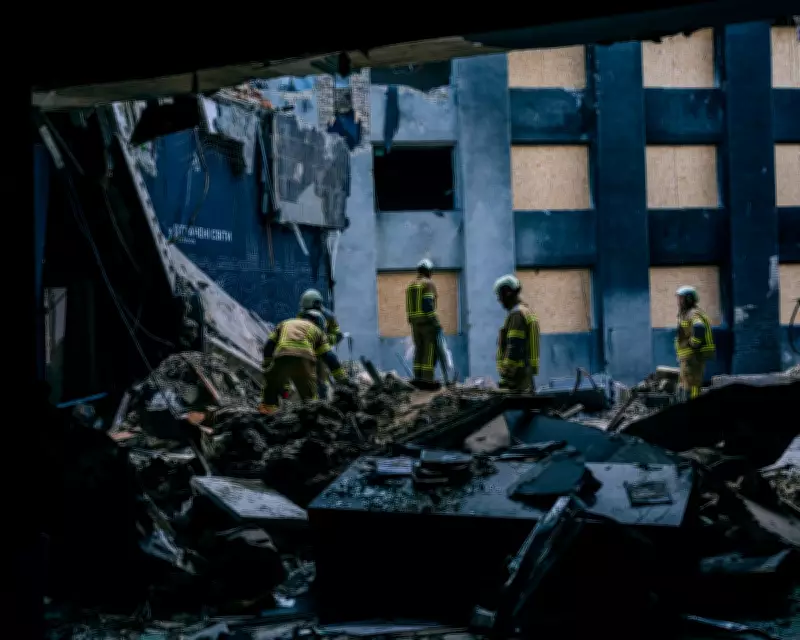
Rescue workers are cleaning up the debris inside the National Chornobyl Museum in Kyiv, where a text on the wall reading ‘Lost worlds’ remains intact amid the destruction. Russia’s recent assault on the capital killed two people, injured 90 more, and significantly damaged many of the city’s museums and cultural sites.
National Chornobyl Museum Devastated
For four years, director Vitalina Martynovska and her team had been working on a complete transformation of Kyiv’s National Chornobyl Museum. The new displays were designed to tell a fresh story about the reactor explosion of 26 April 1986, the most serious nuclear accident in history, which contributed to the collapse of the Soviet Union and continues to shape Ukraine’s identity. The museum reopened to visitors on 26 April, 40 years to the day since the disaster. Then, less than a month later, on the night of 23 May, a shock wave from a Russian missile engulfed the museum’s historic building, a former fire station.
Five days later, a profoundly shocked Martynovska stood among the charred remains. Firefighters toiled amid the absolute destruction of everything she and her team had worked so hard to create. “There is practically no room in the museum that has not suffered damage,” she said. “The building itself sustained significant damage, the roof was destroyed, the floor between the second and third storeys was destroyed, and collapsed; the exhibition rooms and the museum laboratory were affected.” About 40% of the irreplaceable artefacts on display were destroyed, according to early assessments.

Martynovska first heard that her building was on fire around 5am on 24 May. Through the night, Russia sent 60 missiles and 600 drones to Ukraine, most targeted at the capital. The attack killed two people and injured 90 more. “Twenty minutes later, I was already there,” she said. “The first thing I saw was thick smoke and flames on the roof. The windows, doors and gates that were part of this building were already lying on the ground nearby.”
As soon as emergency workers allowed, she and the chief curator plunged into the building to try to save what they could. “We began evacuating the artefacts while the roof was still ablaze and the firefighting operation was still under way. We could hear the roof collapsing. We were constantly wading through water.” The museum stores, housing the bulk of the collection of 22,000 artefacts, were safe. She clutched a pretty earthenware jug that emergency workers had found in the wreckage, and they had also found the tail of a missile.
National Art Museum of Ukraine Damaged
Across town, wind and rain blew into the elegant Doric-pedimented building housing the National Art Museum of Ukraine (Namu). Shock waves had blown out nearly all its windows, ceilings were partly down, and panels from its huge wooden front doors were flung across the foyer. The sculpture of Apollo atop its pediment cracked. Its collection, ranging from ancient icons to Ukrainian modernists, is in storage or on tour abroad. During the full-scale invasion, it has hosted temporary exhibitions; the current show, Sunrise, featuring works by 20th-century painter Anatoly Limarev, was protected by temporary walls that acted as baffle walls. Since the attack, the exhibition has been hastily uninstalled and taken to safety.
In one gallery, the head of exhibitions, a senior conservator, and two students from Kyiv-Mohyla Academy were shovelling rubble into carts. “It’s definitely an internship they won’t forget,” said museum spokesperson Veronika Bublei. In the early morning of 24 May, it was “stress, horrible – we were running about trying to do what we could and there was no time for emotion – or we turned the stress into trying to do something practical. It felt like the epicentre of a tempest, with all the doors and windows blown out – as if a tornado had blown through the building.”

Namu’s director, Yulia Lytvynets, said: “My initial feeling was one of shock. We understand that there is a war going on. Our halls are empty and our art is safe. But you’ll never be 100% ready for something like this. Even if you hide your collection, you can’t hide the building.” The museum had been preparing an exhibition devoted to modernist theatre designer Anatol Petrytskyi, which will now go ahead online. The building is closed to the public indefinitely.
Broader Impact on Cultural Heritage
Numerous cultural buildings and institutions were reported damaged in the city after the night’s attacks, including the Zhytnyi market, a masterpiece of 1980s modernism. According to Ukraine’s culture ministry, the Russian army has “destroyed or damaged 1,723 cultural heritage sites and 2,524 cultural infrastructure sites in Ukraine” since 2022.
Fire raged through a mall and market in the Lukianivka district. At the Mala Opera, a performance venue across the street from the burned-out shopping mall, chief technician Oleksandr Buryma was fitting plastic sheeting over blown-out windows. The roof was damaged, and a section of wall blown out at the rear. But the early 20th-century venue, once a cultural centre for tram workers and now a beloved stage for theatre and music, was still planning to go ahead with its performance on 29 May: Railroad, a play by US writer Bryan Reynolds set amid the rise of nazism. In this case, the show – if it possibly could – would go on.