

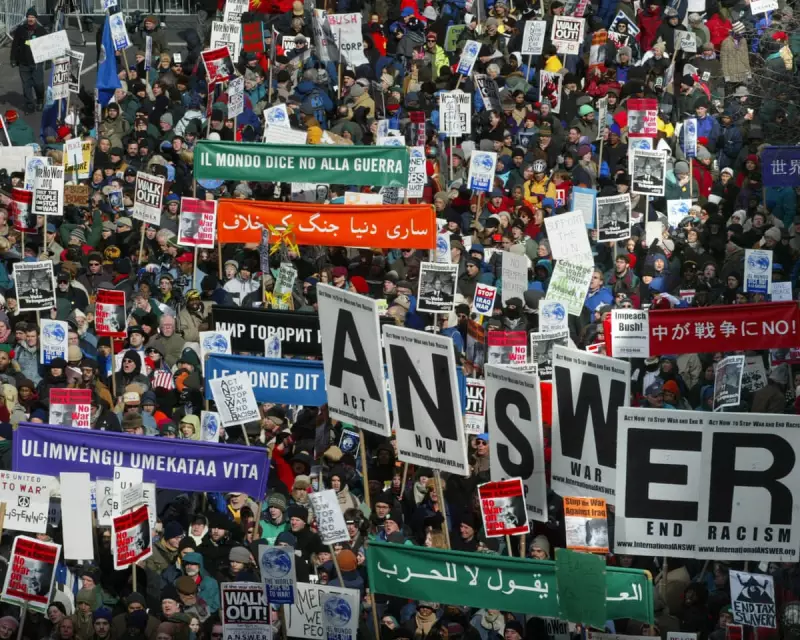
In the spring of 2004, a chilling historical parallel was drawn by General Anthony Zinni regarding the escalating conflict in Iraq. "I spent two years in Vietnam," he stated, "and I've seen this movie before." This grim assessment came a year after President George W. Bush's premature "mission accomplished" declaration, as the war descended into a bloody quagmire. With the Abu Ghraib torture scandal erupting, a raging insurgency, and US casualties nearing 1,000, public support began its dramatic collapse. For the first time, a majority of Americans judged the invasion a "mistake," echoing the warnings of millions who had protested from the outset.
The Iraq Syndrome and the Power of Protest
By the summer of 2005, with Iraq sliding into civil war, support eroded further. Comparisons to Vietnam became commonplace. The public's turning tide had direct political consequences: running against the war, Democrats secured blowout wins in the 2006 midterm elections. The newly empowered Congress established the bipartisan Iraq Study Group, which concluded the war must end. This trajectory was sealed by the election of Barack Obama, who fulfilled his pledge to withdraw US combat troops.
The legacy is stark. By 2019, 62% of American adults and a staggering 58% of Iraq and Afghanistan war veterans believed the conflict was "not worth fighting." This consensus birthed what analysts call an "Iraq syndrome" – a profound public skittishness about large-scale military interventions, mirroring the post-Vietnam era.

A Dismal Sequel? Trump's Aggression and Venezuela
Today, with the capture of Venezuela's Nicolás Maduro, the opening scenes of a dismal sequel may be unfolding. President Donald Trump's approach, however, displays a brazen defiance of traditional constraints. Where the Bush administration sought congressional approval and UN backing for Iraq, Trump openly boasts, "I don't need international law." His aggression relies on "imperialism lite": naval blockades, special operations, targeted strikes, and kidnappings, avoiding for now large-scale "boots on the ground" deployments.
Democratic leaders are explicitly invoking Iraq to frame the danger. Senator Ruben Gallego, an Iraq war veteran, wrote, "I saw my brothers die... all for an unjustified war. No matter the outcome, we are in the wrong for starting this war in Venezuela." Notably, some voices from the MAGA movement, including Steve Bannon and Marjorie Taylor Greene, have also warned against repeating Iraq's mistakes.
Building a Coalition to Halt War Before It Starts
The critical lesson from the 2000s anti-war movement is that while protest did not prevent the invasion of Iraq, it played a decisive role in eroding the war's legitimacy and hastening its end. The movement's narrative of deceitful origins and intolerable costs was gradually validated by events. Figures like Gold Star mother Cindy Sheehan and the later defection of pro-war Democrats like Representative John Murtha demonstrated how public sentiment, shaped by protest, eventually trickled up to the political class.
The task now is more urgent: to stop a major war before it powerfully begins. This requires a broad, visible, and bipartisan coalition. The left cannot alone restrain Trump, who views it as an enemy to be attacked. Anti-war Republicans must be encouraged, despite the intense pressure for loyalty within their ranks. While progressives and some MAGA supporters hold diametrically opposed views on the nature of the Iraq war – seeing it as neo-imperialism versus misguided nation-building – neither side has the luxury of requiring broad affinity for a tactical alliance against a new conflict.
Wins may be relative. In the 1980s, solidarity movements helped forestall full-scale US invasions in Central America, limiting Reagan to proxy wars and covert action—a grim outcome, but one that prevented even greater bloodshed. Today, checking Trump's aggression, even to a form of "imperialism lite," is a vital goal.

The tendency of empire is to overreach. Aggressors promise swift victory, as Bush did when he declared major combat in Iraq over in May 2003, a mere fraction into a decades-long disaster. Trump's propensity is to double down on violence. So much can spiral out of control from initial acts of aggression. If the catastrophe of Iraq holds any lesson, it is that the time to stop a war is before it starts. A new, determined anti-war movement must now make that case, appealing to the hearts and minds of Americans once again.





