

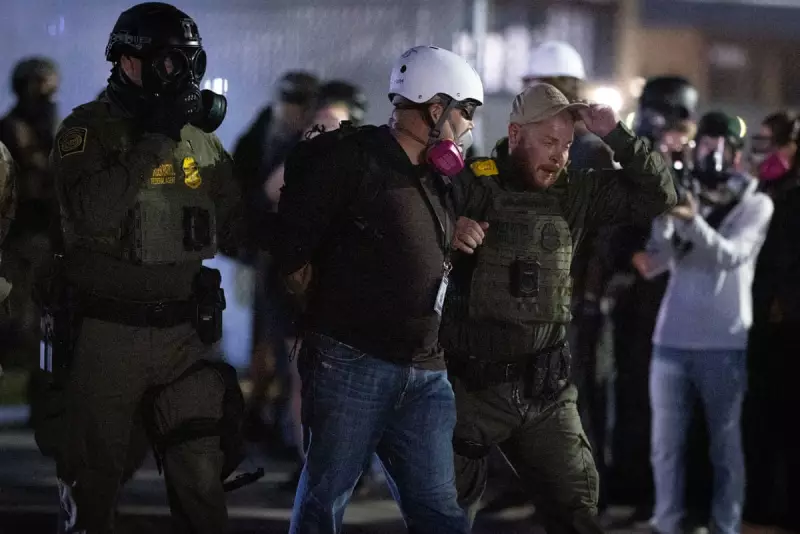
A journalist's arrest by federal agents at a protest in Broadview, Illinois, has intensified calls for the Trump administration to halt violence against the press. The incident, captured in a photograph by Scott Olson of Getty Images, underscores growing tensions as Immigration and Customs Enforcement (ICE) operations escalate.
News Outlets Plead for Dialogue with Homeland Security
Following a year which saw a dramatic rise in violence against US journalists, news organisations and advocacy groups are attempting to open a dialogue with the Department of Homeland Security (DHS). Their goal is to reduce confrontations between law enforcement and the media at protests, particularly those concerning deportations of alleged undocumented immigrants.
The Reporters Committee for the Freedom of the Press and a coalition of New York news outlets have sent letters to the DHS over the last four months. This outreach seeks to establish protocols to keep journalists safe. However, the DHS has not responded to these communications, according to the senders.

This push for protection comes as the administration announces it has hired thousands of new ICE officers and plans to escalate deportation efforts this year. This move, coupled with recent outrage over the killing of a Minnesota woman by an ICE officer, is expected to trigger more protests and potentially more violence targeting journalists.
A Pattern of Assaults and Legal Challenges
Data from the Freedom of the Press Foundation reveals the scale of the problem. The organisation tracked 172 alleged assaults against journalists in the last year, most perpetrated by law enforcement at protests related to immigration policies. Between 2022 and 2024, there were 175 alleged assaults in total.
Gabe Rottman, Vice-President of Policy for the Reporters Committee, argues a key issue is a lack of training for DHS officers on interacting with the press. Unlike the Department of Justice, which has formal news media guidelines developed with the Committee, the DHS has no such framework.
"It’s crucial that officers be trained to permit journalists to remain on the scene even when they are issuing a dispersal order," Rottman stated. He emphasised that journalists not obstructing police work may have a First Amendment right to stay and report.
The consequences of this lack of training are stark. Ryanne Mena, a reporter for the Southern California News Group, was struck by a pepper-ball bullet and later a rubber bullet fired by DHS agents at separate Los Angeles protests, suffering a concussion. She wore press credentials on both occasions.
Mena and others subsequently filed a lawsuit, leading a federal judge to issue a temporary injunction in September. The ruling stated DHS officers cannot legally disperse anyone they know or should know is a journalist without probable cause for a crime unrelated to a dispersal order.
Administration Response and an Uncertain Future
When questioned by the Guardian about the letters from news organisations, DHS Assistant Secretary Tricia McLaughlin focused on dangers faced by ICE officers, claiming a 1,150% increase in assaults against them. However, investigations by the Los Angeles Times and National Public Radio found the actual increase was closer to 25%.
McLaughlin stated that while officers take precautions, covering unlawful activities "does come with risks." The DHS has appealed the federal injunction, arguing that protecting journalists from dispersals could expose officers to harm from individuals wearing fraudulent press credentials.
With 10,000 new ICE agents reportedly coming on board and morale described as "high" by Border Patrol official Gregory Bovino, immigration reporters anticipate a busy and potentially hazardous year ahead.
Carroll Bogert, CEO of the New York outlet the City, who wrote to DHS officials in December, remains pragmatic about the outreach efforts. "I don’t want to sound naive, but I think it’s important to have made the effort," she said. "Should disputes arise over ICE treatment of journalists … it will behoove us to have tried."
Whether this push for dialogue will make any tangible difference in protecting journalists covering increasingly volatile protests remains to be seen.






