

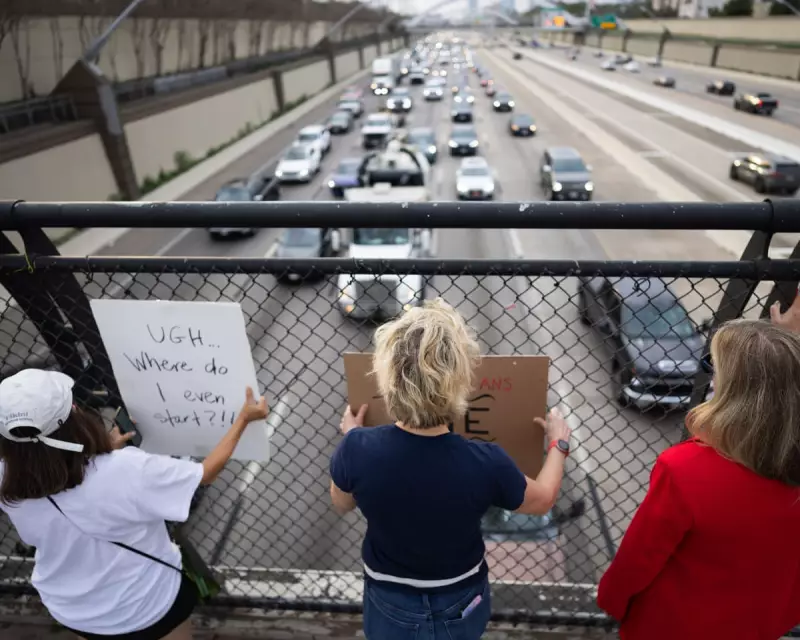
In the wake of Donald Trump's return to office, a new form of hyperlocal and highly visible protest has emerged across the United States. From Montana to New Jersey, activists are taking to highway overpasses, using bold signs to deliver urgent political messages to thousands of passing motorists.
The Spark: A Death in Minneapolis and a Rapid Response
The catalyst for the latest wave of action was the death of ICE observer Renee Nicole Good in Minneapolis on 7 January. Bonnie Connery, upon hearing the news, quickly mobilised her local Missoula Visibility Brigade in Montana. By that same afternoon, a group of twenty were on the South Reserve Street Pedestrian Bridge, hanging signs reading "ICE THUGS KILL CITIZEN" and "DHS LIES" for rush-hour traffic to see.
Connery explained the strategic choice of location, noting drivers were travelling from the more liberal city of Missoula into conservative surrounding areas. This incident triggered a synchronised response. Within hours, similar Visibility Brigades assembled on overpasses in Paramus, New Jersey; Palo Alto, California; St Paul, Minnesota; and Louisville, Kentucky.

Beyond Spontaneity: A Growing Grassroots Network
While these protests appear impromptu, they are the product of months of organised effort. Dana H Glazer, a national leader with the Visibility Brigade, stated their goal is to disrupt the public's "veneer of normalcy." The strategy focuses on immediate, repeatable actions that are hard to ignore.
Since March 2025, more than 250 local Visibility Brigades have formed nationwide. These groups, alongside organisations like 50501 which helped lead the larger No Kings protests, are advocating for sustained local action against Trump-era policies. "These local protests are easy to sustain on a weekly basis," Glazer said, emphasising their reach to thousands of daily commuters.
Local Action, Regional Reach: The Hunterdon County Example
The model proves effective even in politically conservative areas. In Hunterdon County, New Jersey—where most municipalities voted for Trump in 2024—former police chief Robert Quinlan organised a protest on 4 January against military action in Venezuela. His group of 35 braved an ice-covered bridge with "NO WAR FOR OIL" signs.
Quinlan highlighted the advantage over larger rallies, saying, "I've attended many larger protests... but it seemed like sometimes we were preaching to the choir." He estimates up to 20,000 people see their messages during a two-hour protest on Interstate 78, achieving a broader regional reach.
Organisers cite theories like the "3.5% rule" by Harvard's Erica Chenoweth, which posits that meaningful political change requires active participation from at least 3.5% of the population. The Visibility Brigades aim to build that critical mass through distributed, local action.
Platforms like Mobilize.us have seen a significant uptick in activity, with 64% of new users creating events for the first time since Trump's second term began, indicating a surge in grassroots organising.
Sustaining Momentum: Joy, Creativity and Community
Despite the serious messages, many brigades inject creativity and joy into their actions. In Orlando, Candy Powell's group wears jailbird costumes and dances on overpasses with signs reminding people of the January 6th Capitol attack. "If we make videos... and it looks fun, people might want to join in on the joy," Powell explained.
In Brooklyn, artist Julie Peppito co-organises "Freedom Fridays" at a busy intersection, using symbolic signs with melting ice cubes and clear imagery to communicate instantly. She believes that if such a protest existed on every corner, it would form an "undeniable" national web of resistance.

Rebecca Winter of Mass 50501 underscores the practical benefits: these actions create community safety nets, share resources, and combat political paralysis by showing people they are not alone. The movement's core philosophy is clear: consistent, local, and highly visible dissent is a powerful tool in the face of national policy shifts.





