

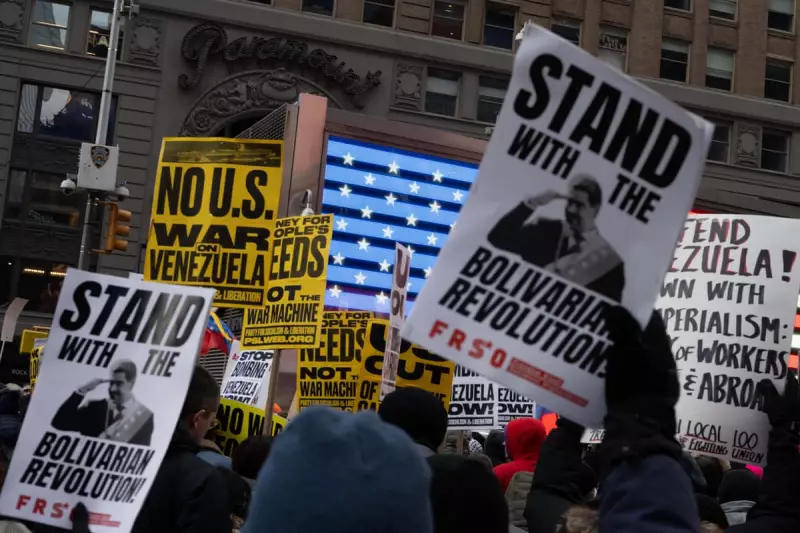
Demonstrations swept across major United States cities over the weekend, as hundreds gathered to voice fierce opposition to President Donald Trump's unilateral military intervention in Venezuela and the dramatic capture of the country's leader, Nicolás Maduro.
Coast-to-Coast Condemnation of Military Action
Protests erupted from New York to San Francisco, with significant gatherings also reported in Chicago, Dallas, Philadelphia, Pittsburgh, and Seattle. The rallies, coordinated by groups including The People's Forum and Answer Coalition, condemned the US military operation early on Saturday which resulted in Maduro being taken into custody. He is now held in a federal detention centre in Brooklyn and is scheduled to appear in a New York federal court at noon local time on Monday to face drug-trafficking charges.
In San Francisco, demonstrators marched down Market Street to United Nations Plaza. In Chicago, protesters assembled at the Dirksen Federal Building Plaza. A common thread was the accusation that the US action violated international law and Venezuelan sovereignty. "We're creating wars, we're creating chaos and then simultaneously abducting our neighbors and sending them back to the very countries that we're destabilizing," said Olivia DiNucci, an organiser with Code Pink, in an interview with Philadelphia's WHYY radio.

Political and Constitutional Backlash
The military move has sparked a significant political controversy within the US, beyond the street protests. Senior Democrats have decried President Trump for bypassing Congress, arguing he lacked the constitutional authority to launch such a strike without legislative approval. Internationally, critics say the operation breaches the United Nations charter.
While some Republican lawmakers initially praised the action, there was notable backpedalling from Trump's Saturday claim that the US "will run" Venezuela during a transition. Despite this, figures like Congressman Tom Emmer called Trump a "president of peace." The incident highlights a deep partisan divide, even as there is bipartisan condemnation of Maduro's own regime.
Solidarity and Calls for Release
Outside the Brooklyn detention centre, a crowd chanted "Free Maduro right now," illustrating the complex sentiments among activists who oppose US interventionism regardless of their view of the Venezuelan president. Protest signs across the country carried messages like "No Blood for Oil" and "Stop Bombing Venezuela Now!"
Andy Thayer of the Chicago Committee Against War and Racism summarised a core protester belief to a local ABC affiliate: "Whenever the United States attacks another country like this, it's the peoples of those countries who suffer the most." Taylor Young, an Answer organiser in Seattle, emphasised the use of tax dollars to fund actions they see as violations of self-determination.
The protests underscore a turbulent moment in US foreign policy, marked by direct military action, domestic dissent, and uncertain political consequences both at home and abroad.






