

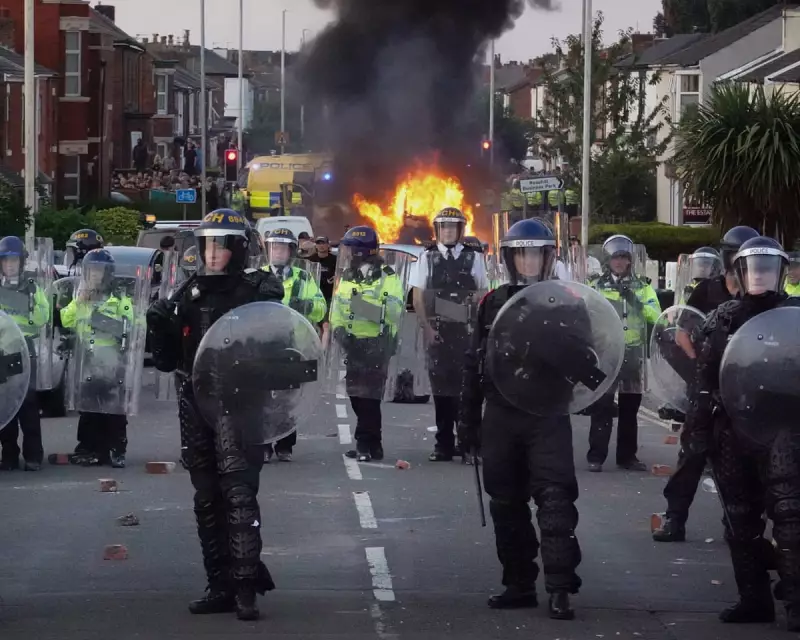
A major new report has accused the UK government and justice system of failing to address the deep-seated racism and social deprivation that fuelled the widespread riots across England and Northern Ireland in the summer of 2024. The analysis warns that treating the violence merely as 'mindless' thuggery risks legitimising further far-right mobilisation.
Echoes of Government Rhetoric in Courtroom Justifications
The violence was triggered by the tragic murder of three young girls in Southport, after which false online claims that the perpetrator was an asylum seeker spread rapidly. The Institute of Race Relations (IRR) thinktank commissioned criminologist Dr Jon Burnett to study court cases stemming from the disturbances.
Burnett's paper found that defendants' justifications for their actions frequently mirrored divisive political and media narratives. He noted that former Conservative Prime Minister Rishi Sunak's "stop the boats" slogan and its associated policy framework, which he said was continued by the subsequent Labour government, was repeatedly echoed by those involved.

"Other defendants echoed dominant narratives that the state had not gone far enough, accusing the government of aiding and abetting an 'invasion'," Burnett wrote. He concluded that while the forces were complex, the ideological positions used to justify violence often aligned with those promoted by politicians and parts of the media over time.
A Punitive 'One-Size-Fits-All' Judicial Response
The report strongly challenges the notion of a 'two-tier justice system' in the response to the riots. Instead, it highlights a punitive approach that also swept up Muslim and other Black and Minority Ethnic (BME) individuals who mobilised to defend their communities from far-right groups.
It identified dozens of cases where these community defenders faced harsh sentences. In some instances, judges were reported to have made comments suggesting that "racial abuse is unpleasant, but you should have risen above it".
Andrea Coomber KC, chief executive of the Howard League for Penal Reform, stated: "The 'two-tier justice' narrative is particularly misleading. Both government and the courts prioritised a 'one-size-fits-all' response of speedy prosecutions and punitive sentencing, an approach that swept up many vulnerable people from across different backgrounds."
Ignored Root Causes and a Warning for the Future
The report is critical of the government's failure to examine how its own policies contributed to the unrest. Burnett argued that ministers did not consider whether deprivation caused by long-term state policies was a factor, or if economic neglect allowed the far right to gain a foothold in areas feeling abandoned.
Liz Fekete, director of the IRR, issued a stark warning: "Unless society comes to terms with the deeper causes of anti-migrant, Islamophobic and racist violence we will be caught in a vicious cycle... with the prospect of ugly protests and riots forming an infinite loop."
Rajiv Menon KC said the report depicts "the wholly inadequate response of a government and a criminal justice system incapable of addressing the role of racism in the riots".
In response, a government spokesperson said their immediate focus was protecting targeted communities and that they are now developing a longer-term strategy. They pointed to the £5bn 'Pride in Place' investment across 250 areas aimed at improving lives and localities to address underlying frustrations.






