

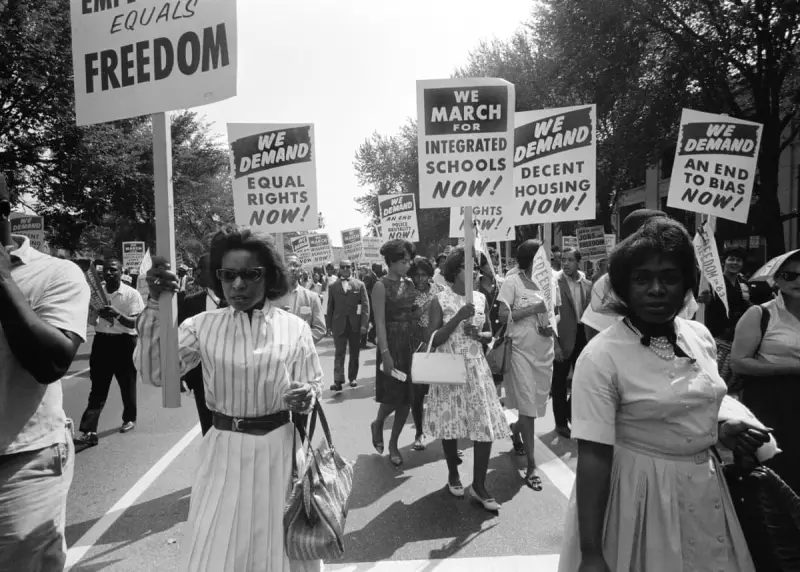
From the iconic March on Washington in 1963 to the historic Women's March of 2017, collective action has repeatedly shaped the trajectory of American society. Historians and political scientists agree: protest is a profoundly effective tool for change. It has driven legislation from women's suffrage to marriage equality and sparked deep cultural shifts on issues from racial bias to bodily autonomy.
Protests as a Catalyst for Electoral Change
When organiser Carmen Perez-Jordan helped plan a national women's rights protest following Donald Trump's 2016 election victory, she did not foresee it becoming the largest single-day protest in American history. On 21 January 2017, over 500,000 people filled the streets of Washington D.C., with an estimated 4 million participating nationwide.
Looking back, Perez-Jordan states the Women's March engaged millions in activism for the first time, inspired movements like #MeToo, and broadened the conversation around women's issues. Research confirms its tangible impact, most notably in prompting an unprecedented surge of female candidates. During the 2018 midterms, more than 500 women ran for congressional seats, nearly doubling the 2016 figure.

Studies show regions with higher protest turnout saw positive shifts in votes for Democratic candidates. This effect isn't limited to the left; areas with greater participation in the 2009 Tea Party protests saw increased Republican support in the 2010 midterms. Researchers note a single protester can rally more support for a cause than a single vote in an election.
The Lasting Legacy: Building Movements and Networks
Protest participation often fosters lifelong civic engagement. Research on participants in the 1964 Freedom Summer—a campaign to register Black voters in Mississippi—found they were more likely to remain activists throughout their lives compared to those who intended to join but didn't.
"It tells us that the impact of protesting is more about action than intent," explains Jeremy Pressman, a political science professor at the University of Connecticut. "Being in it teaches you a skillset and makes you feel comfortable in that setting."
This builds coalitions and networks vital for future campaigns. Pressman calls this "organisational success," measurable through growth in membership, funding, or media attention. In close-knit communities, seeing a local protest can empower individuals who previously felt isolated in their views, creating a powerful sense of solidarity.
Why Nonviolence Remains a Key to Success
One strategy has consistently proven most effective in the US context: nonviolent resistance. The civil rights movement, from the Montgomery bus boycott to the Greensboro sit-ins, demonstrated extreme discipline in maintaining nonviolent tactics.
This approach works to create a sympathetic movement that sways public opinion. The movement's ability to elicit violent opposition—such as the 1965 attack on peaceful marchers at the Edmund Pettus Bridge in Selma, Alabama—often strengthened public support for the cause.
Conversely, protests involving violent tactics, even by a minority, tend to lose public support. This was observed during the 2017 Charlottesville counter-protests, where footage of brawling lowered public esteem for the anti-racist demonstrators. Similarly, destructive tactics like property damage or blocking major highways often provoke a negative public reaction.
Beyond Policy: The Personal Impact of Protest
While legislative change is a crucial marker, success can also be measured by a protest's impact on its participants. Protesting can significantly improve emotional wellbeing. For instance, participants in the ACT UP movement of the 1980s and 90s, which demanded action on HIV/Aids, reported feeling validated years later.
"It is important not to get so focused on big-picture consequences that we lose sight of protest as a way to hold on to one’s agency," says Omar Wasow, an assistant professor at UC Berkeley. Shifting the framework to consider whether participants feel effective, hopeful, and part of a community is vital.

Protests rarely spark overnight change; their impact is often a gradual cascade. Viewing them through a historical lens—over years or decades—helps appreciate the tangible effect of taking to the streets. As Wasow concludes, "These are long-term fights." The evidence is clear: from suffrage to civil rights, the collective voice from the streets has repeatedly redirected the course of history.





