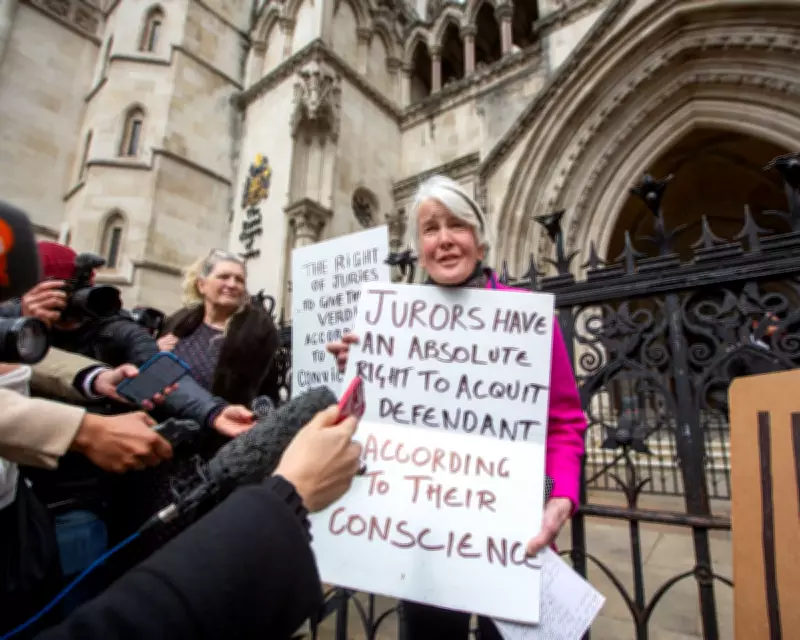
Climate Campaigner's Contempt Case Dismissed Amid Jury Rights Controversy
In a significant legal development, climate campaigner Trudi Warner saw her contempt case thrown out by a judge in 2024. Warner had been arrested for holding a placard defending the rights of juries, sparking a broader debate about the role of juries in the British justice system.
The Historical Importance of Jury Trials
The English criminal jury system, developed over eight centuries, has long been regarded as one of the fairest methods for determining guilt or innocence worldwide. A jury of twelve randomly selected individuals serves as a crucial bulwark against government overreach and oppressive legislation, providing a unique constitutional safeguard for democratic principles.
These fundamental principles have come under scrutiny during recent debates over the Labour government's proposals to reduce the number of jury trials by half. This move appears not because juries are ineffective or unfair, but precisely because they conscientiously return verdicts that challenge government positions and reflect genuine public notions of justice.

Government's Changing Position on Juries
Deputy Prime Minister and Justice Secretary David Lammy presents a particularly striking example of this policy reversal. In June 2020, Lammy tweeted emphatically that "jury trials are a fundamental part of our democratic settlement" and that "criminal trials without juries are a bad idea."
Yet Lammy now proposes judge-only trials for offences likely to attract sentences of less than three years, including serious crimes such as theft, fraud, wounding, and burglary. This represents a complete volte-face from his previous position, raising questions about the consistency of government policy.
The Real Reasons Behind Proposed Changes
The government cites a shocking criminal court backlog of more than 80,000 cases, projected to reach 100,000 by 2028, as justification for reducing jury trials. However, no evidence has been presented to establish a causal link between jury trials and this backlog.
Independent analyses, including from the Institute for Government and Sir Brian Leveson's review of the criminal justice system, suggest the backlog stems primarily from chronic underfunding rather than the jury system itself. Leveson specifically identified "chronic underfunding at every step" as the most significant cause of the current crisis.
Risks of Reducing Jury Trials
There are substantial concerns that reducing jury trials could lead to increased miscarriages of justice. Trials presided over solely by judges, without the safeguard of a diverse jury, risk becoming more susceptible to judicial cynicism and case-hardened perspectives.
Additionally, judges sitting alone would face the onerous task of compiling detailed reasoned judgments, potentially adding considerable delays to trial conclusions. This contradicts the government's stated goal of reducing court backlogs.
Historical Precedents and Modern Examples
The importance of jury independence dates back to the 1670 case of Mr. Bushell, who with fellow jurors refused to convict Quakers William Penn and William Mead despite judicial pressure. More recently, the Hillsborough inquest jury demonstrated ordinary citizens' capacity for complex deliberation, sitting for nearly two years and returning fourteen detailed narrative findings that contradicted official government positions.
These examples underscore how juries have historically served as a check on government power and official narratives, protecting basic human rights against oppressive legislation.
The Broader Political Context
The debate over jury rights occurs against a backdrop of increasing government restrictions on protest rights and free speech. While successive governments have passed laws curtailing rights to protest and assemble, juries have consistently acquitted significant numbers of those charged under these laws.
This tension highlights what human rights lawyer Michael Mansfield KC describes as "a sacred principle being sacrificed to falsely explain systemic failure." The wisdom of ordinary people serving on juries represents a bedrock democratic principle now under threat from what appears to be arbitrary governance.

As the government moves forward with proposals to reduce jury trials, the dismissal of Trudi Warner's contempt case serves as a reminder of the ongoing struggle to preserve this fundamental aspect of British justice and democracy.