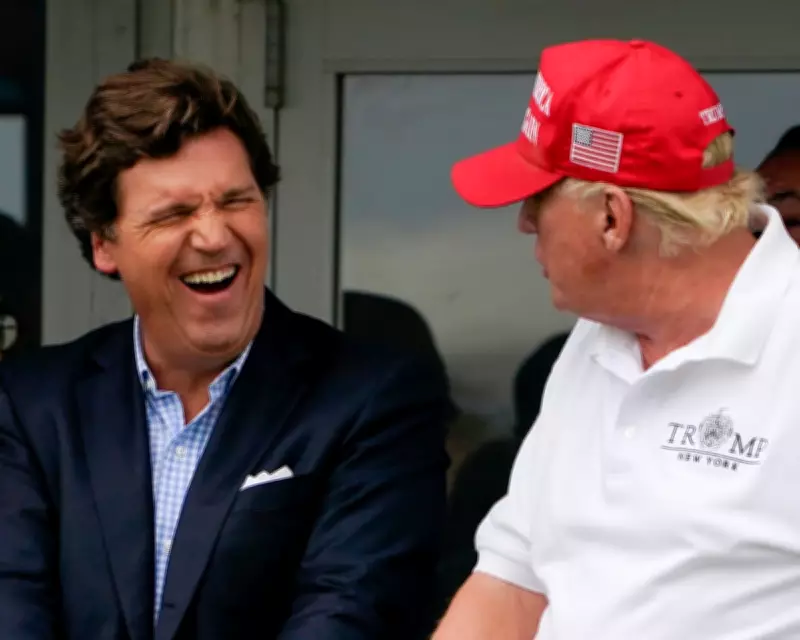
In a stunning reversal, prominent conservative commentator Tucker Carlson has openly expressed profound regret for his longstanding support of former President Donald Trump, describing himself as deeply "tormented" by his role in advancing Trump's political career. The unexpected mea culpa occurred during a candid discussion on Carlson's own podcast, The Tucker Carlson Show, where he engaged in a soul-searching conversation with his brother, Buckley Carlson, a former speechwriter for Trump.
A Public Apology and Political Reckoning
"We'll be tormented by it for a long time—I will be," Tucker Carlson confessed during the emotional exchange. "And I want to say I'm sorry for misleading people. It was not intentional, that's all I'll say." This remarkable admission marks a significant departure for Carlson, who was once among Trump's most vocal media allies, frequently campaigning for him and speaking at his events throughout multiple election cycles.
The Evolution of a Political Relationship
The relationship between Carlson and Trump represents a complex political journey. Despite having referred to Trump as "the single most repulsive person on the planet" back in 1999, Carlson became an early supporter who correctly predicted Trump's serious political potential ahead of the 2016 presidential election. His support continued through Trump's successful 2024 re-election campaign, with Carlson appearing at a Trump campaign event just five days before election night.

However, the current rift between the two figures has deepened considerably over fundamental policy disagreements, particularly concerning U.S. foreign policy in the Middle East. Carlson has become increasingly critical of Trump's approach to Israel and the war that erupted in Iran in late February, describing the president's language on the conflict as "vile on every level."
Taking Personal Responsibility
During his podcast conversation, Carlson emphasized his personal accountability for Trump's return to power. "You and I and everyone else who supported him—you wrote speeches for him, I campaigned for him—I mean, we're implicated in this for sure," he told his brother. "It's not enough to say, 'Well, I changed my mind'—or like 'Oh, this is bad—I'm out.'"
The commentator elaborated on this sense of responsibility, stating, "In very small ways, but in real ways, you and me and millions of people like us are the reason this is happening right now." This acknowledgment represents a significant moment of reflection for a media personality who has played a substantial role in shaping conservative political discourse.
Escalating Tensions and Public Criticism
Carlson's revisionist stance follows increasingly public tensions with the former president. Trump recently launched a social media attack against Carlson, labeling him "a Low IQ person—Always easy to beat, and highly overrated!!!" The former president also threatened to compile "a list of good, bad, and somewhere in the middle" supporters from his Make America Great Again movement.
Earlier in April, Carlson offered additional critical commentary during an appearance on Newsmax, remarking, "I've always liked Trump and still feel sorry for him—as I do for all slaves. He's hemmed in by other forces. He can't make his own decisions. It's awful to watch." This characterization reflects Carlson's evolving perspective on Trump's autonomy and decision-making capacity.
Religious Imagery and Controversial Comparisons
The political commentary took an unexpected theological turn when Carlson questioned whether Trump might represent "the antichrist" following the former president's verbal attacks on Pope Leo XIV, an American-born critic of the Iran war. This speculation emerged after Trump shared an artificial intelligence-generated image depicting himself as Jesus Christ on social media.
"He's mocking Jesus. He's making fun of Christianity. The central figure of the religion is being held up for mockery," Carlson observed on his podcast. "Could this be the antichrist? Well, who knows? At least that's my conclusion. Who knows?" This dramatic rhetorical question underscores the depth of Carlson's disillusionment with his former political ally.

Criticism of Foreign Policy Decisions
Carlson reiterated his objections to Trump's handling of international conflicts during his recent comments, particularly focusing on the Iran war. "He clearly had no plan for it, wasn't enthusiastic about it, was fully aware of the risks, fully aware that it was a betrayal of his explicit promises for 10 years not to do this—he did it and did it against his will," Carlson asserted, highlighting what he perceives as contradictions between Trump's campaign promises and presidential actions.
Professional Context and Controversial History
Carlson's current criticism of Trump follows his 2023 dismissal from Fox News after fourteen years with the network. His departure occurred shortly after Fox News reached a substantial $787.5 million settlement with Dominion Voting Systems, which had sued the network for broadcasting false claims about the company's involvement in alleged election fraud during the 2020 presidential race that saw Joe Biden defeat Trump.
Since leaving Fox News, Carlson has launched his own media company and generated additional controversy through various actions and statements. These include an October interview with Nick Fuentes, a known antisemitic white supremacist, as well as previous promotions of unconventional practices like testicle tanning during his Fox tenure. His enthusiastic praise of a Russian grocery store in 2024, two years after Russia's military invasion of Ukraine, also drew significant criticism.
The conservative commentator's public reckoning with his support for Donald Trump represents a notable moment in American political media, highlighting the evolving relationships between prominent conservative voices and the political figures they once championed. As Carlson continues to navigate his post-Fox career while re-evaluating his political alliances, his journey reflects broader tensions within conservative media and the Republican party as both entities grapple with their identities in the post-Trump political landscape.