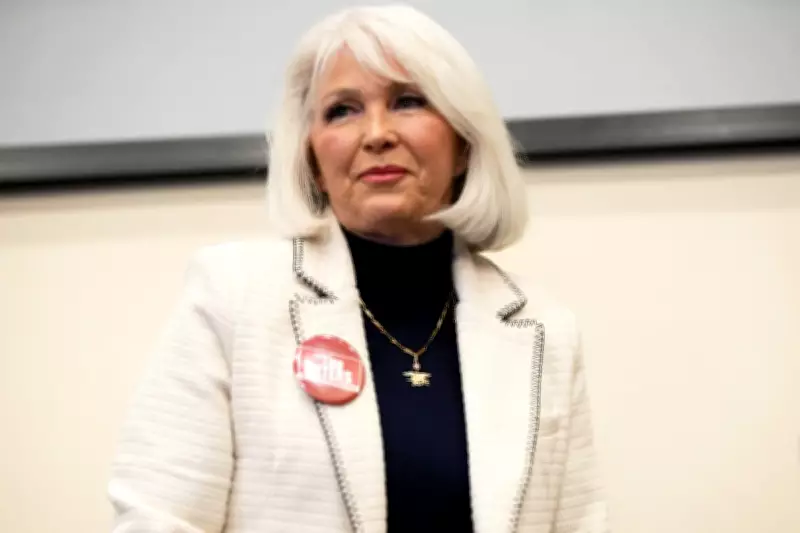
Colorado Governor Jared Polis Considers Clemency for Election Denier Tina Peters
In a development stirring significant political debate, a lawyer representing Tina Peters has expressed confidence that Democratic Colorado Governor Jared Polis will commute her nine-year prison sentence. Peters, the former Mesa County clerk, is the only individual currently incarcerated for attempts to overturn the 2020 election results, making her case a focal point in ongoing discussions about election integrity and justice.
Background of the Case and Legal Proceedings
Tina Peters served as the county clerk in western Colorado's Mesa County during the 2020 election. She was found guilty by a jury in 2024 on multiple charges, including three counts of attempting to influence a public servant, conspiracy to commit criminal impersonation, first-degree official misconduct, violation of duty, and failure to comply with the secretary of state. Her actions involved allowing an unauthorized person to access voting equipment using a security badge, which led to sensitive information, such as passwords, being leaked. This data was subsequently exploited by election deniers to cast doubt on the 2020 election outcomes.
Despite a federal pardon issued earlier this year by former President Donald Trump, Peters' conviction remains unaffected as it pertains to state crimes. Trump has consistently advocated for her pardon as part of his broader campaign to disseminate misinformation about the 2020 election.

Governor Polis's Stance and Public Reaction
Governor Jared Polis recently signaled his consideration of clemency for Peters, drawing parallels to the case of former state senator Sonya Jaquez Lewis. Lewis was convicted of similar felonies, including attempting to influence a public official, but received a sentence of probation and community service. In a post on X, Polis emphasized the need for consistent application of justice, stating, "Justice in Colorado and America needs to be applied evenly, you never know when you might need to depend on the rule of law."
However, this potential move has sparked immediate concern among Colorado officials. Secretary of State Jena Griswold, a Democrat, argued that the cases are not comparable, highlighting that Peters' actions breached election equipment and undermined democratic processes. Griswold warned that granting clemency could set a dangerous precedent, especially as Peters' actions continue to be used to challenge future elections.
Opposition from Political Figures and Legal Experts
The prospect of clemency has faced strong opposition from various quarters. A survey by The Colorado Sun revealed that no Democratic state legislators support reducing Peters' sentence, with state representative Karen McCormick labeling the idea as "ridiculous." U.S. Senator Michael Bennet, who is running for governor, asserted that Peters knowingly violated the law and should not receive special treatment, stressing the importance of upholding democratic institutions.
Dan Rubinstein, the district attorney who prosecuted Peters, condemned any modification of her sentence as a "gross injustice." He explained that sentencing ranges exist to account for varying circumstances and consequences of crimes, implying that Peters' severe impact on election security justifies her lengthy term.
Implications and Future Outlook
Peter Ticktin, Peters' lawyer, predicted that clemency could be granted imminently, based on more than mere speculation. He noted that a Colorado appeals court had previously expressed skepticism about the severity of her sentence during a hearing. Peters' case has become a rallying point for Trump and his supporters, who view her incarceration as symbolic of broader electoral controversies.
As Governor Polis deliberates, the decision will likely influence perceptions of justice and election security in Colorado and beyond. The outcome could either reinforce the rule of law or raise questions about political leniency in high-profile cases involving election interference.